
If an object moves through a nonzero distance, can it have zero displacement? Give one supporting example.
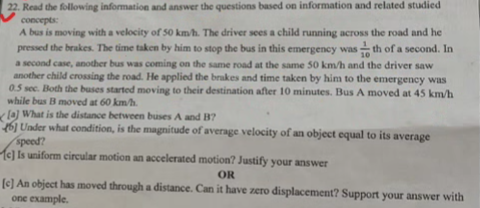
Yes. An object can travel a nonzero distance and still have zero displacement if it ends at the same position where it started, because displacement depends only on initial and final positions. Example: walking 10 m east and then 10 m west gives a total distance of 20 m, but the displacement is 0 m.
What the question is really asking
You are comparing two different ways to describe motion: how much ground an object covers versus how far it ends up from where it started.
Distance versus displacement
- Distance is the total path length traveled. It is always nonnegative.
- Displacement is the change in position, including direction. In one dimension:
$$\text{displacement} = x_f - x_i$$
So displacement can be zero even when distance is not.
When displacement becomes zero
Displacement is zero exactly when the final position equals the initial position:
$$x_f = x_i \Rightarrow x_f - x_i = 0$$
This happens on any round trip, loop, or back-and-forth motion that returns to the start.
Example that supports the answer
Start at a point on a straight line.
- Walk $10\,\text{m}$ east, then $10\,\text{m}$ west.
- Total distance traveled:
$$10 + 10 = 20\,\text{m}$$
- Displacement:
$$x_f - x_i = 0\,\text{m}$$
You moved, so the distance is not zero, but you ended where you began, so the displacement is zero.

- Instantaneous Speed vs Average Speed (13.5 mph)
- Acceleration when stopping from 83 km/h in 4.0 s
- Speed of an Object Dropped from 10 m (Free Fall)
- Time of Flight and Maximum Height (Tower Throw)
- Average Acceleration of Blood in a Heart Stroke
- Does Constant Acceleration Mean a Straight-Line Path?
- Projectile Maximum Height — Ball Thrown Upward at 12 m/s
- Average velocity from an x vs. t graph (0,10) to (50,40)
Comments (0)
Please to leave a comment.