
In the x vs. t (position vs. time) graph described in the source text, the particle’s position changes along a straight line from (t = 0 s, x = 10 m) to (t = 50 s, x = 40 m). What is the overall displacement Δx of the particle in meters?
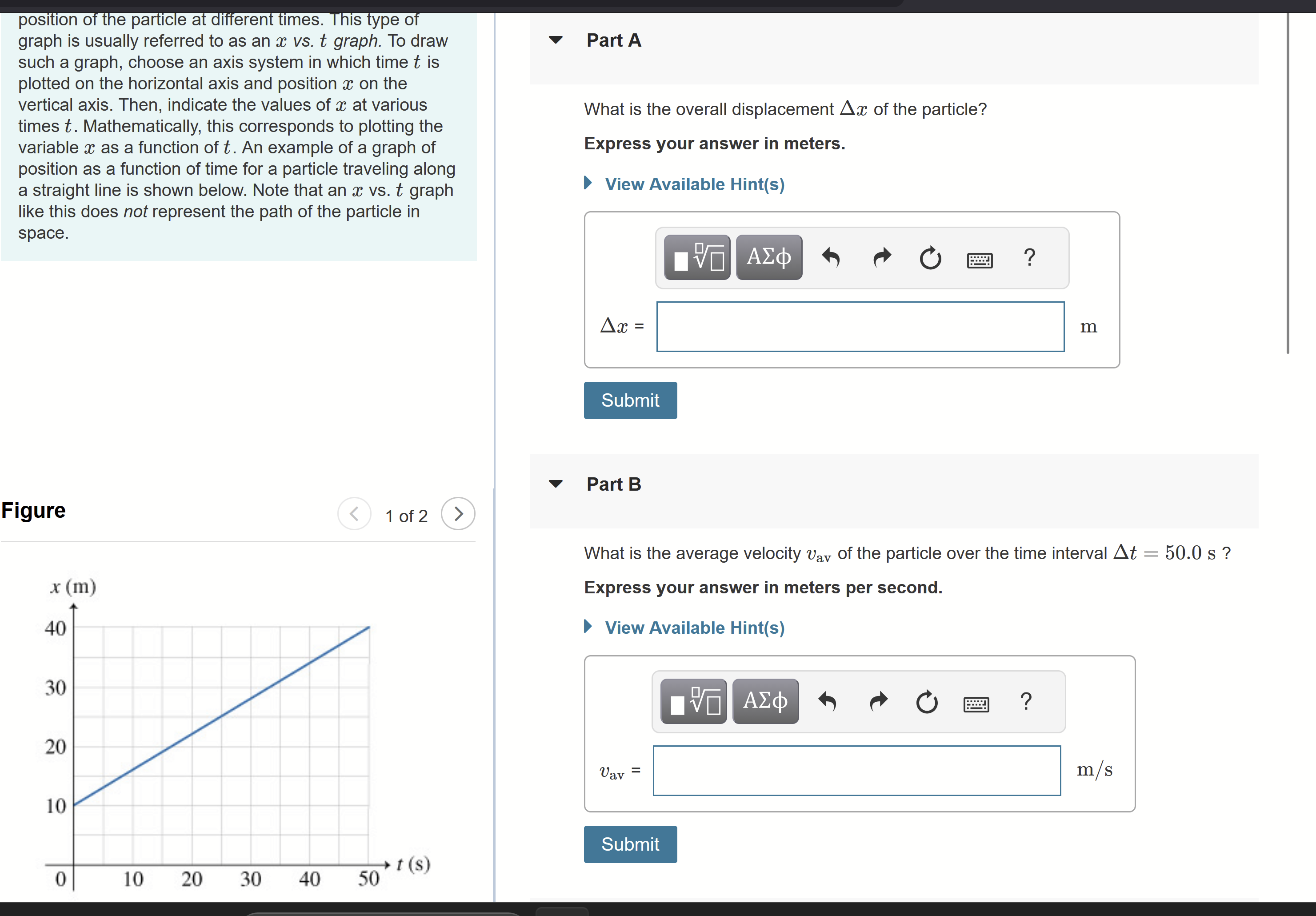
The overall displacement is the final position minus the initial position: $\Delta x = x_f - x_i = 40\,\text{m} - 10\,\text{m} = 30\,\text{m}$. So, the particle’s displacement is $30\,\text{m}$.
What the x vs. t graph tells you
An $x$ vs. $t$ graph shows the particle’s position $x$ at each time $t$. Displacement depends only on the starting and ending positions, not on the shape of the path in space.
Read the initial and final positions from the graph description
- Initial point: $(t=0\,\text{s},\ x=10\,\text{m})$, so $x_i = 10\,\text{m}$
- Final point: $(t=50\,\text{s},\ x=40\,\text{m})$, so $x_f = 40\,\text{m}$
Compute displacement
Use the definition: $$\Delta x = x_f - x_i$$ Substitute the values: $$\Delta x = 40 - 10 = 30\,\text{m}$$
Quick check on the sign
Because the final position is larger than the initial position, the displacement is positive, so $\Delta x = +30\,\text{m}$.

- Instantaneous Speed vs Average Speed (13.5 mph)
- Acceleration when stopping from 83 km/h in 4.0 s
- Speed of an Object Dropped from 10 m (Free Fall)
- Time of Flight and Maximum Height (Tower Throw)
- Average Acceleration of Blood in a Heart Stroke
- Does Constant Acceleration Mean a Straight-Line Path?
- Projectile Maximum Height — Ball Thrown Upward at 12 m/s
- Average velocity from an x vs. t graph (0,10) to (50,40)
Comments (0)
Please to leave a comment.