
If the price elasticity of demand for coconuts is -1.0 and when the price is Rs. 60 the demand is 6000 coconuts, what will be the price when the quantity demanded is 2400 coconuts? (Options: 1) Rs. 60 2) Rs. 10 3) Rs. 30 4) Rs. 5 5) Rs. 60)
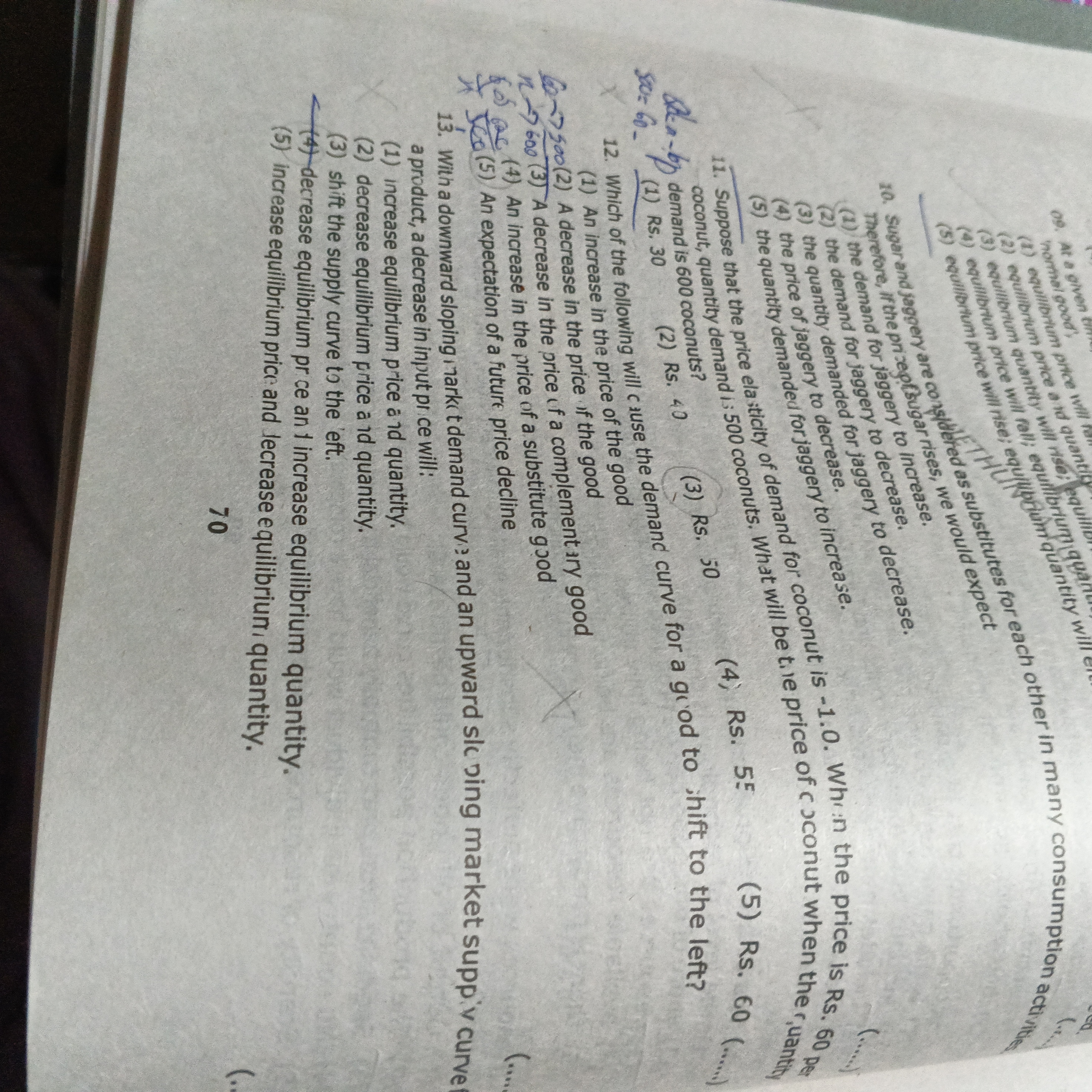
With price elasticity of demand equal to -1 (unitary elasticity), total expenditure stays constant, so $P_1Q_1=P_2Q_2$. Here $P_2=\frac{60\times 6000}{2400}=150$, so the price should be Rs. 150. This value is not listed in the given options.
What the elasticity value tells you
A price elasticity of demand of $-1.0$ means demand is unit elastic. In that case, price and quantity change in opposite directions in the same proportion, and total spending (total revenue) stays the same.
Use the unit-elastic (constant expenditure) rule
For unit elastic demand: $$P_1Q_1=P_2Q_2$$ Given:
- $P_1 = 60$
- $Q_1 = 6000$
- $Q_2 = 2400$
So, $$P_2=\frac{P_1Q_1}{Q_2}=\frac{60\times 6000}{2400}=\frac{360000}{2400}=150$$
Quick reasonableness check
Quantity falls from $6000$ to $2400$, which is $0.4$ of the original. With unit elasticity, price must rise by the reciprocal factor: $1/0.4 = 2.5$. Then $60\times 2.5=150$, consistent.
Matching to the provided choices
Rs. 150 is the correct result, but it does not appear among options (1) to (5), so the options seem to contain an error or omission.

- Price Elasticity of Demand from a Demand Schedule
- Marginal Cost From Total Cost and Output Change
- Open Market Purchase by the Fed: Money Supply Effect
- Short-Run Profit Maximization and Firm Entry Assumption
- Why Firms Produce with Losses (Short-Run Rule)
- Oranges Price Elasticity of Demand (PED) — Solved
- Per-Unit Cigarette Tax and Tax Revenue: True/False
- Utilità U=XY²: paniere ottimo ed effetti del prezzo
Comments (0)
Please to leave a comment.