
Using Table 3 (price £1.20, quantity 1800; price £1.50, quantity 2700), calculate the price elasticity of supply of loaves of bread when the price rises from £1.20 to £1.50.
Price per loaf of bread (£) | Quantity of loaves of bread made per week
1.20 | 1800
1.50 | 2700
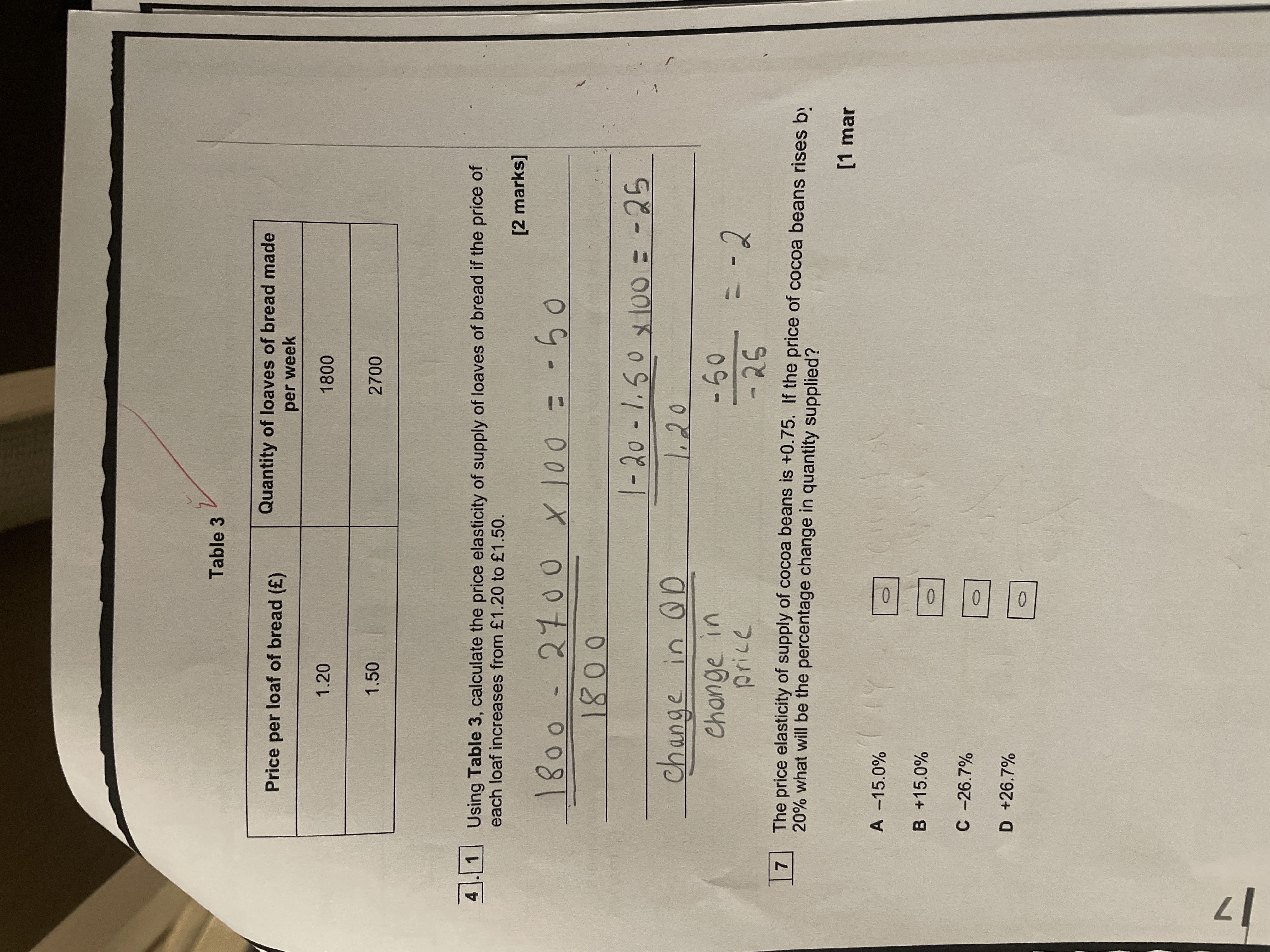
The price elasticity of supply (PES) is 2.0. Quantity supplied rises from 1800 to 2700 (a 50% increase) while price rises from £1.20 to £1.50 (a 25% increase), so $\text{PES} = 50\% \div 25\% = 2.0$, meaning supply is price elastic.
What you are being asked to measure
Price elasticity of supply tells you how responsive quantity supplied is to a change in price. You compare the percentage change in quantity supplied with the percentage change in price.
Work out the percentage change in quantity supplied
- $\Delta Q = 2700 - 1800 = 900$
- Percentage change (using the starting value): $$\%\Delta Q = \frac{900}{1800} \times 100 = 50\%$$
Work out the percentage change in price
- $\Delta P = 1.50 - 1.20 = 0.30$
- Percentage change (using the starting value): $$\%\Delta P = \frac{0.30}{1.20} \times 100 = 25\%$$
Calculate PES and interpret it
$$\text{PES} = \frac{\%\Delta Q}{\%\Delta P} = \frac{50}{25} = 2.0$$ Since $\text{PES} > 1$, the supply of loaves of bread is elastic, meaning quantity supplied changes proportionally more than price.

- Why Firms Produce with Losses (Short-Run Rule)
- Capital goods are purchased by firms: True or False
- Will Vegetable Supply Increase After Health Diet News?
- Price Elasticity of Supply from $1 to $3 (Table)
- Economic Profit in Monopolistic Competition (TR $2800)
- Minimum Price Above Equilibrium: Surplus or Shortage?
- Elasticity of Supply: 0.75 and a 20% Price Rise
- Equilibrio e imposta con U(X,Y)=(X-2)Y | Micro
Comments (0)
Please to leave a comment.