
Prepare a Departmental Trading Account for departments X, Y, and Z given opening stock and purchases in units, sales units at selling prices (X: 1,020 units at ₹20; Y: 1,920 units at ₹22.50; Z: 2,496 units at ₹25), total purchases value ₹1,00,000, and the same gross profit rate in each department.
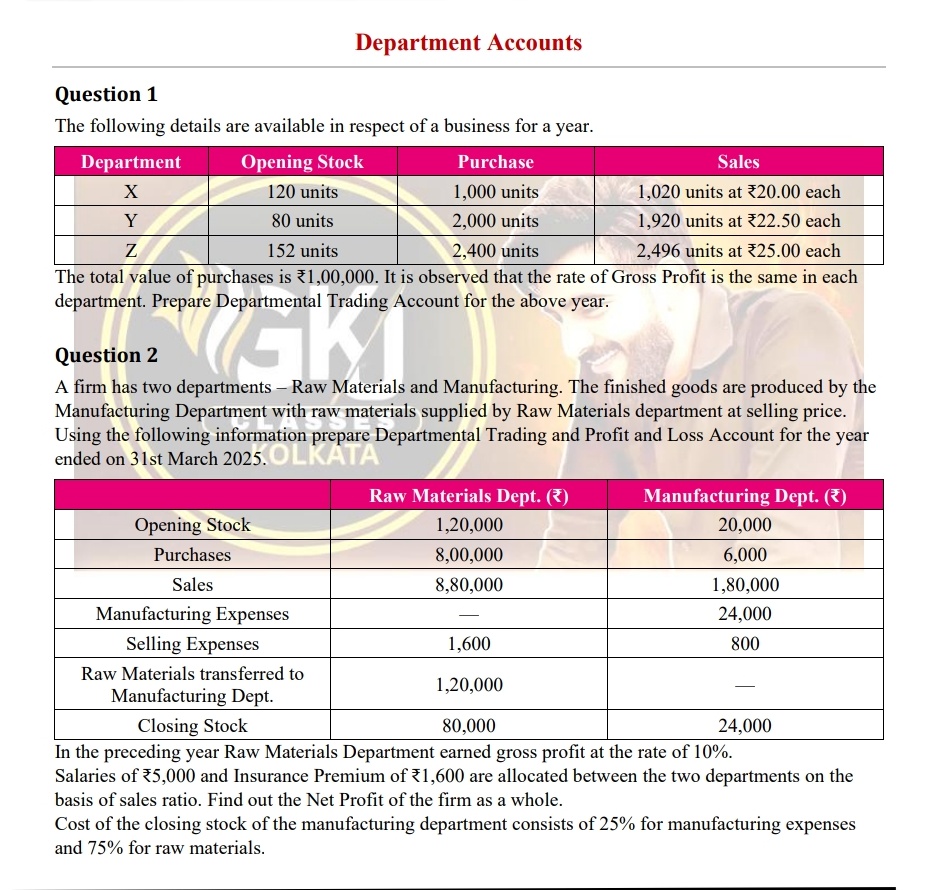
The gross profit rate is 20% on sales in each department (cost of sales is 80% of sales). This gives cost per unit: X ₹16, Y ₹18, Z ₹20, so purchases split as X ₹16,000, Y ₹36,000, Z ₹48,000 (total ₹1,00,000). Closing stock values are X ₹1,600 (100 units), Y ₹2,880 (160 units), and Z ₹1,120 (56 units). The departmental gross profits are X ₹4,080, Y ₹8,640, and Z ₹12,480.
What we are trying to find
You are told that all three departments earn the same gross profit (GP) rate, but only the total purchases value (₹1,00,000) is given. So we first find the common GP rate, then compute each department’s cost per unit, and finally prepare the Departmental Trading Account.
Step 1: Compute sales value and closing stock units
Sales value:
- Dept X: $1{,}020 \times 20 = ₹20{,}400$
- Dept Y: $1{,}920 \times 22.50 = ₹43{,}200$
- Dept Z: $2{,}496 \times 25 = ₹62{,}400$
Closing stock units (units available less units sold):
- Dept X: $120 + 1{,}000 - 1{,}020 = 100$ units
- Dept Y: $80 + 2{,}000 - 1{,}920 = 160$ units
- Dept Z: $152 + 2{,}400 - 2{,}496 = 56$ units
Step 2: Use “same GP rate” to relate cost per unit to selling price
Let cost-to-sales ratio be $k$ (same for each department). Then: $$\text{COGS} = k \times \text{Sales}$$ But also, with a constant cost per unit within each department: $$\text{COGS} = (\text{units sold}) \times (\text{cost per unit})$$ So for each department, $$\text{cost per unit} = k \times \text{selling price}$$ Therefore:
- $c_X = 20k$
- $c_Y = 22.5k$
- $c_Z = 25k$
Step 3: Use total purchases value ₹1,00,000 to find $k$
Total purchases value: $$1{,}000c_X + 2{,}000c_Y + 2{,}400c_Z = 100{,}000$$ Substitute $c_X=20k$, $c_Y=22.5k$, $c_Z=25k$: $$1{,}000(20k) + 2{,}000(22.5k) + 2{,}400(25k) = 100{,}000$$ $$20{,}000k + 45{,}000k + 60{,}000k = 100{,}000$$ $$125{,}000k = 100{,}000 \Rightarrow k = 0.8$$ So cost is $80\%$ of sales, and GP is $20\%$ of sales.
Cost per unit:
- Dept X: $c_X = 20 \times 0.8 = ₹16$
- Dept Y: $c_Y = 22.5 \times 0.8 = ₹18$
- Dept Z: $c_Z = 25 \times 0.8 = ₹20$
Step 4: Value opening stock, purchases, closing stock, and compute GP
Purchases (value):
- X: $1{,}000 \times 16 = ₹16{,}000$
- Y: $2{,}000 \times 18 = ₹36{,}000$
- Z: $2{,}400 \times 20 = ₹48{,}000$
Opening stock (value):
- X: $120 \times 16 = ₹1{,}920$
- Y: $80 \times 18 = ₹1{,}440$
- Z: $152 \times 20 = ₹3{,}040$
Closing stock (value):
- X: $100 \times 16 = ₹1{,}600$
- Y: $160 \times 18 = ₹2{,}880$
- Z: $56 \times 20 = ₹1{,}120$
GP (20% of sales):
- X: $0.20 \times 20{,}400 = ₹4{,}080$
- Y: $0.20 \times 43{,}200 = ₹8{,}640$
- Z: $0.20 \times 62{,}400 = ₹12{,}480$
Departmental Trading Account (₹)
| Particulars | Dept X | Dept Y | Dept Z |
|---|---|---|---|
| Debit side | |||
| Opening Stock | 1,920 | 1,440 | 3,040 |
| Purchases | 16,000 | 36,000 | 48,000 |
| Total (Debit) | 17,920 | 37,440 | 51,040 |
| Credit side | |||
| Sales | 20,400 | 43,200 | 62,400 |
| Closing Stock | 1,600 | 2,880 | 1,120 |
| Gross Profit (balancing figure) | 4,080 | 8,640 | 12,480 |
| Total (Credit) | 26,080 | 54,720 | 76,000 |
(Each department shows GP = 20% of sales, as required.)

- Cost of Goods Sold for a Merchandising Company
- Petty Cash and Cash Short/Over Journal Entries
- Net Income for June (Chris Bates Transactions)
- Sales Book and Sales Account With 10% Trade Discount
- Scritture contabili acquisto impianti e leasing
- Bilancio in forma abbreviata: parti che lo compongono
- Crediti verso soci: assenti se azioni liberate
- Journal Entries for Disposal of Machines (Gain/Loss)
Comments (0)
Please to leave a comment.