
Show that the vectors (3, 0, -3), (-1, 1, 2), (4, 2, -4), and (2, 1, 1) are linearly dependent over ℝ.
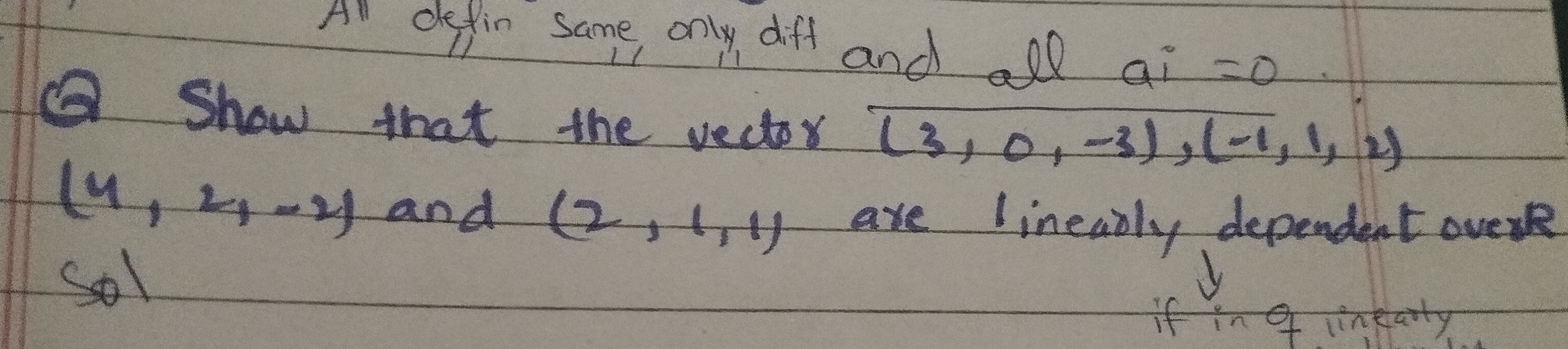
They are linearly dependent because a nontrivial linear combination equals the zero vector: $$-3(3,0,-3) -3(-1,1,2) + (4,2,-4) + (2,1,1) = (0,0,0).$$ Equivalently, $(4,2,-4) + (2,1,1) = 3(3,0,-3) + 3(-1,1,2)$, so one vector is a linear combination of the others.
What you need to show
To prove these vectors are linearly dependent, you just need to find one set of real numbers, not all zero, such that $$a(3,0,-3)+b(-1,1,2)+c(4,2,-4)+d(2,1,1)=(0,0,0).$$
Turn the vector equation into a system
Match coordinates component-by-component: $$3a-b+4c+2d=0$$ $$b+2c+d=0$$ $$-3a+2b-4c+d=0$$
Solve the homogeneous system
From the second equation, $$b=-2c-d.$$ Substitute into the first: $$3a-(-2c-d)+4c+2d=0$$ $$3a+6c+3d=0 \,\Rightarrow\, a+2c+d=0 \,\Rightarrow\, a=-2c-d.$$ Now substitute $a=-2c-d$ and $b=-2c-d$ into the third equation: $$-3(-2c-d)+2(-2c-d)-4c+d=0$$ $$6c+3d-4c-2d-4c+d=0$$ $$-2c+2d=0 \,\Rightarrow\, d=c.$$ Then $$a=-2c-d=-3c, \quad b=-2c-d=-3c.$$ Choose $c=1$ (any nonzero value works). Then $$a=-3,\; b=-3,\; c=1,\; d=1.$$
Write the dependence relation clearly
Plugging these coefficients back gives $$-3(3,0,-3) -3(-1,1,2) + (4,2,-4) + (2,1,1) = (0,0,0).$$ Since the coefficients are not all zero, the four vectors are linearly dependent over $\mathbb{R}$.

- Basis for the Column Space of Matrix A
- Rango de T(x,y,z)=(2x+7y,7y+2z,2x−z)
- Valores de a y b para que T sea lineal
- Incenter Angle Bisector Problem: Find m∠BCP
- Type of Data: Water Intake (L/day) From Cows
- Evaluate $h(-1)$ for $h(x)=-5x^3+x+2$
- Probability a Batch Is Accepted (3 Tested, 0 Failures)
- Conditional Probability From a Gender-Carrier Table
Comments (0)
Please to leave a comment.