
In the velocity-time graph of a particle with points A(10 s, 10 m/s), B(20 s, 10 m/s), and C(40 s, 0 m/s) (with O at 0 s, 0 m/s), what are the acceleration values along OA, AB, and BC in m/s²? A) 1, 0, -0.5 B) 1, 0, 0.5 C) 1, 1, 0.5 D) 1, 0.5, 0
- Vertical axis: v (m/sec)
- Horizontal axis: t (in sec.)
- Points: A (t=10, v=10), B (t=20, v=10), C (t=40, v=0)
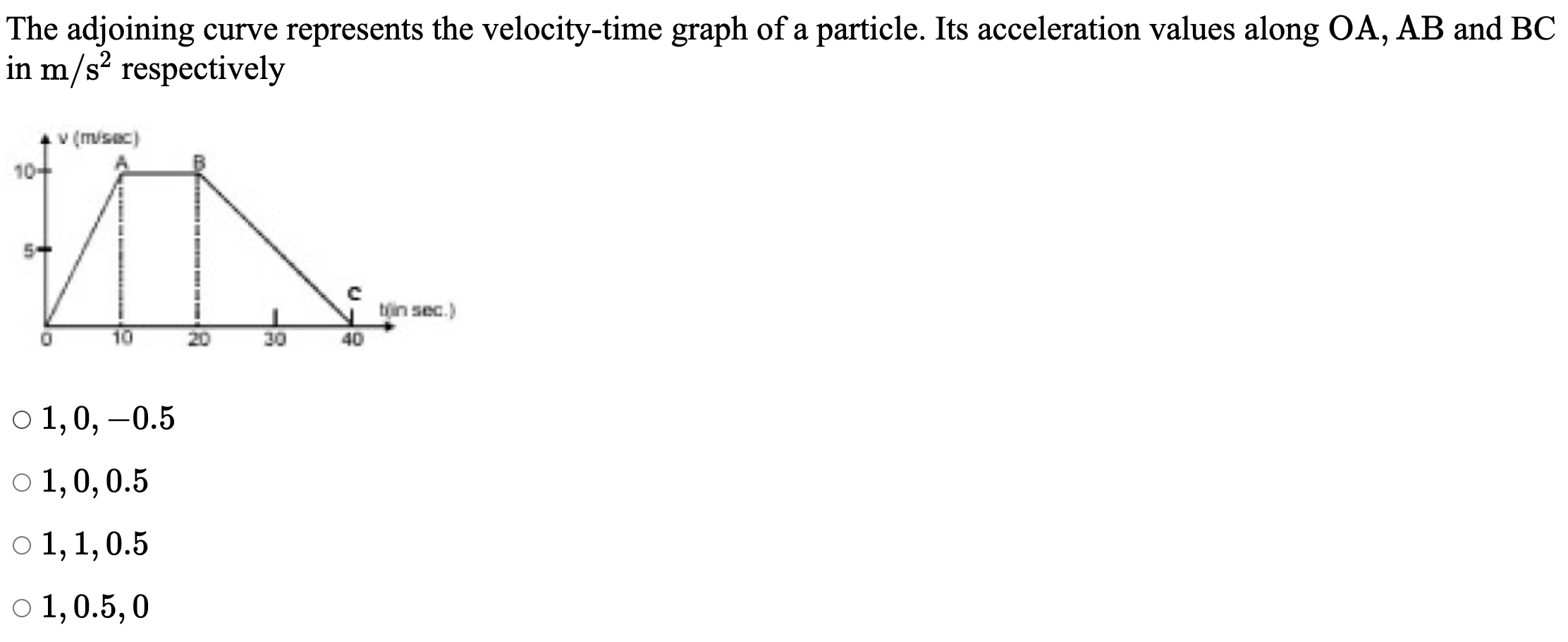
Acceleration is the slope of the velocity-time graph, $a=\Delta v/\Delta t$. Along $OA$: $(10-0)/(10-0)=1\,\text{m/s}^2$; along $AB$: $(10-10)/(20-10)=0$; along $BC$: $(0-10)/(40-20)=-0.5\,\text{m/s}^2$. So the correct option is A) $1, 0, -0.5$.
What the graph is telling you
On a velocity-time ($v$-$t$) graph, the acceleration on any straight segment is the gradient (slope). So each part $OA$, $AB$, and $BC$ has a constant acceleration equal to $\Delta v/\Delta t$ on that segment.
Acceleration along $OA$
Point $O=(0,0)$ and $A=(10,10)$.
$$a_{OA}=\frac{\Delta v}{\Delta t}=\frac{10-0}{10-0}=1\,\text{m/s}^2$$
Acceleration along $AB$
Points $A=(10,10)$ and $B=(20,10)$.
$$a_{AB}=\frac{10-10}{20-10}=0\,\text{m/s}^2$$
This makes sense because $AB$ is horizontal, the velocity is constant.
Acceleration along $BC$
Points $B=(20,10)$ and $C=(40,0)$.
$$a_{BC}=\frac{0-10}{40-20}=\frac{-10}{20}=-0.5\,\text{m/s}^2$$
The negative sign shows the particle is slowing down.
Matching to the options
The values are $1, 0, -0.5$, which matches Option A.

- Instantaneous Speed vs Average Speed (13.5 mph)
- Acceleration when stopping from 83 km/h in 4.0 s
- Speed of an Object Dropped from 10 m (Free Fall)
- Time of Flight and Maximum Height (Tower Throw)
- Average Acceleration of Blood in a Heart Stroke
- Does Constant Acceleration Mean a Straight-Line Path?
- Projectile Maximum Height — Ball Thrown Upward at 12 m/s
- Average velocity from an x vs. t graph (0,10) to (50,40)
Comments (0)
Please to leave a comment.