
In Set 2: Angular Kinematics, a motor starts from rest and accelerates at a constant 2 rad/s² for 5 seconds. What is its final angular velocity (ωₓ)?
Use the constant acceleration equations: ωₓ = ωᵢ + αt, θ = ωᵢt + 1/2 αt², and ωₓ² = ωᵢ² + 2αθ.
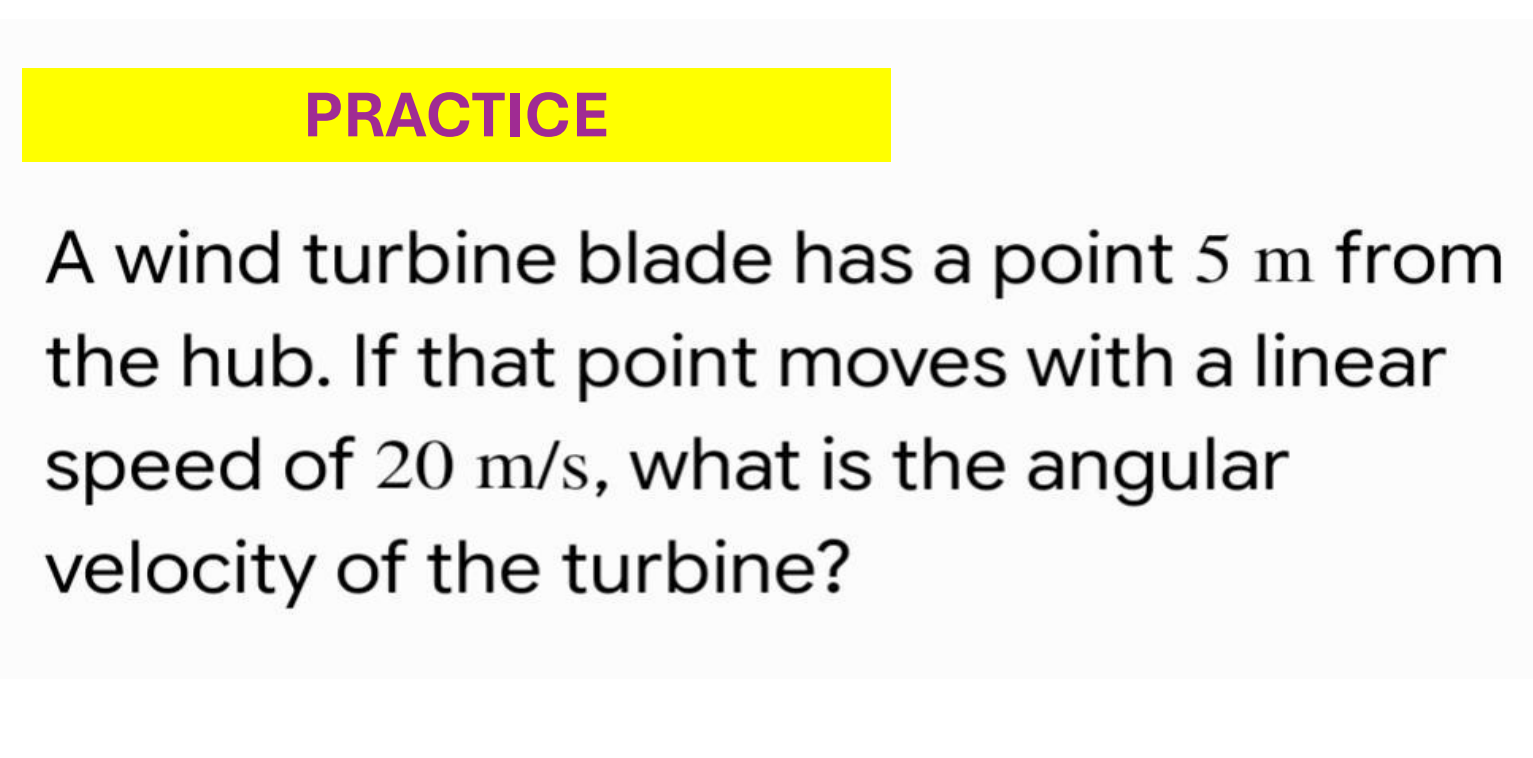
The final angular velocity is $\omega_x = 10\ \text{rad/s}$. Using $\omega_x = \omega_i + \alpha t$ with $\omega_i = 0$, $\alpha = 2\ \text{rad/s}^2$, and $t = 5\ \text{s}$ gives $\omega_x = 0 + 2(5) = 10\ \text{rad/s}$.
What the problem is asking
You are given a constant angular acceleration and a time interval, starting from rest. With constant acceleration, you can use the linear-in-time kinematics equation for angular speed.
Pick the correct angular kinematics equation
From the set of constant-acceleration equations, use: $$\omega_x = \omega_i + \alpha t$$
Substitute the given values
- Starts from rest, so $\omega_i = 0\ \text{rad/s}$
- Angular acceleration: $\alpha = 2\ \text{rad/s}^2$
- Time: $t = 5\ \text{s}$
Now compute: $$\omega_x = 0 + (2)(5) = 10\ \text{rad/s}$$
Quick reasonableness check
An acceleration of $2\ \text{rad/s}^2$ means the angular speed increases by $2\ \text{rad/s}$ each second. After $5$ seconds, the increase should be $5 \times 2 = 10\ \text{rad/s}$, which matches.

- Electric Field on the Axis of a Charged Ring
- Parallel circuit diagram: 1 battery, 3 lights, switch
- Hammer vs Feather in Vacuum: Which Value Differs?
- 52T and 9T bike gear ratio: wheel turns per crank
- Particles in Solids vs Gases Table Answers
- Angle of Refraction as the Dependent Variable
- Change in Temperature of Heated Copper Pipe
- Reazione vincolare con forza a 45° su piano liscio
Comments (0)
Please to leave a comment.