
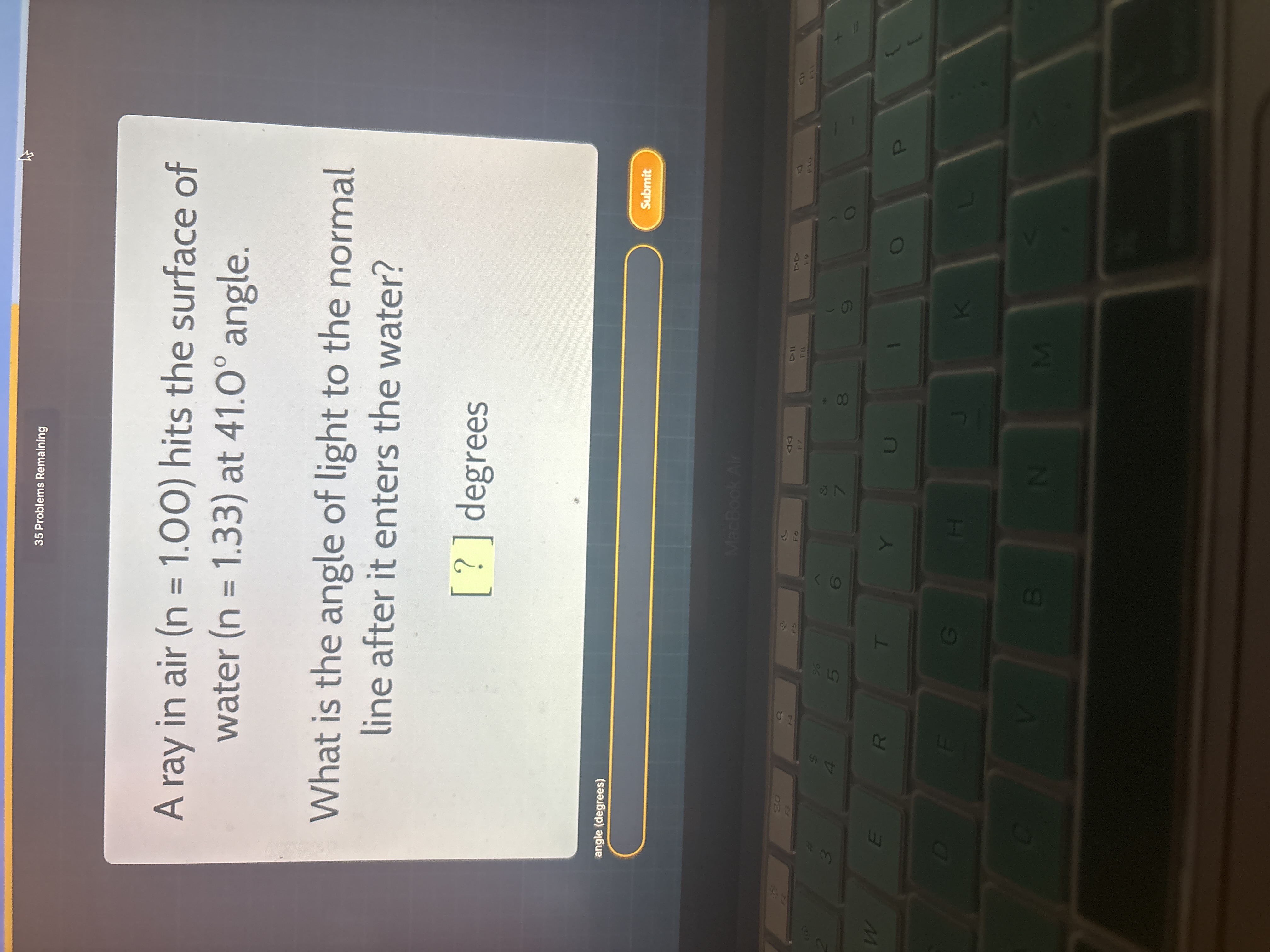
A ray in air (n = 1.00) hits the surface of water (n = 1.33) at an angle of 41.0° to the normal. What is the angle to the normal after the light enters the water?
Using Snell’s law, $n_1\sin\theta_1=n_2\sin\theta_2$. With $n_1=1.00$, $n_2=1.33$, and $\theta_1=41.0^\circ$, $\sin\theta_2=(1.00/1.33)\sin41.0^\circ\approx0.493$, so $\theta_2\approx29.6^\circ$.
What you are solving
When light crosses from one medium to another, its direction changes (refraction). The angle is always measured from the normal line (a line perpendicular to the surface).
Apply Snell’s law
Snell’s law is $$n_1\sin\theta_1=n_2\sin\theta_2.$$ Here:
- $n_1=1.00$ (air)
- $n_2=1.33$ (water)
- $\theta_1=41.0^\circ$
Solve for $\theta_2$: $$\sin\theta_2=\frac{n_1}{n_2}\sin\theta_1=\frac{1.00}{1.33}\sin(41.0^\circ).$$ Compute: $$\sin(41.0^\circ)\approx0.6561$$ $$\sin\theta_2\approx\frac{1.00}{1.33}(0.6561)\approx0.4933$$
Convert back to an angle
$$\theta_2=\sin^{-1}(0.4933)\approx29.6^\circ.$$
Since water has a higher refractive index than air, the ray bends toward the normal, so the refracted angle is smaller than $41.0^\circ$, which matches $29.6^\circ$.

- Parallel circuit diagram: 1 battery, 3 lights, switch
- Electric Field on the Axis of a Charged Ring
- Hammer vs Feather in Vacuum: Which Value Differs?
- Particles in Solids vs Gases Table Answers
- 52T and 9T bike gear ratio: wheel turns per crank
- Angle of Refraction as the Dependent Variable
- Reazione vincolare con forza a 45° su piano liscio
- Change in Temperature of Heated Copper Pipe
Comments (0)
Please to leave a comment.