
A thin circular ring of mass M and radius R rotates about its axis with angular velocity ω. If two objects of mass m each are gently attached at opposite ends of a diameter on the ring, what is the new angular velocity of the ring? (a) Mω/(M + m) (b) ω(M − 2m)/(M + 2m) (c) Mω/(M + 2m) (d) ω(M + 2m)/M
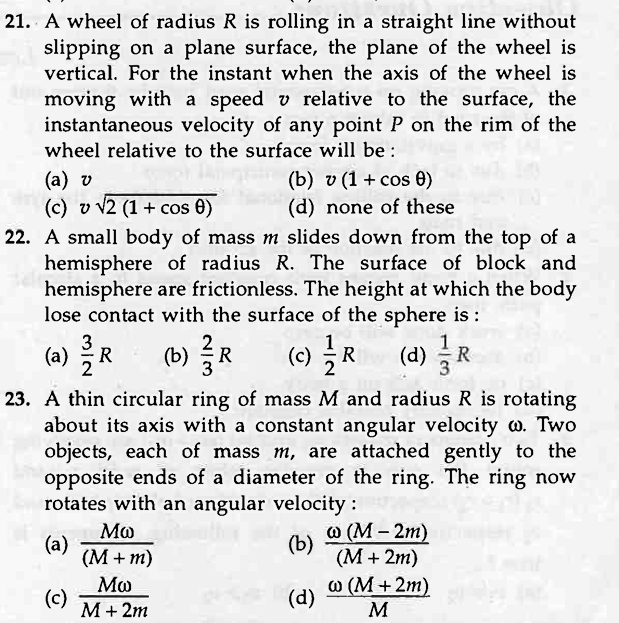
The new angular velocity is $\omega' = \dfrac{M\omega}{M+2m}$. This follows from conservation of angular momentum: initially $I_i = MR^2$, and after attaching the two masses at radius $R$, $I_f = MR^2 + 2mR^2$, so $MR^2\omega = (MR^2+2mR^2)\omega'$. The correct option is (c).
What changes when the masses are attached
Attaching two masses to the ring does not change the axis of rotation, but it increases the moment of inertia about that axis. Since the masses are attached gently and symmetrically, we treat the process as having no external torque about the axis, so angular momentum about the axis is conserved.
Initial angular momentum of the rotating ring
For a thin circular ring about its symmetry axis, $$I_i = MR^2.$$ So the initial angular momentum is $$L_i = I_i\omega = MR^2\omega.$$
New moment of inertia after adding two masses
Each object of mass $m$ is at distance $R$ from the axis, so each contributes $mR^2$.
Total final moment of inertia: $$I_f = MR^2 + 2(mR^2) = (M+2m)R^2.$$
Using conservation of angular momentum to find $\omega'$
With no external torque, $$L_i = L_f \quad\Rightarrow\quad I_i\omega = I_f\omega'.$$ Substitute $I_i$ and $I_f$: $$MR^2\omega = (M+2m)R^2\,\omega'.$$ Cancel $R^2$: $$\omega' = \frac{M\omega}{M+2m}.$$
So the correct choice is (c).

- Electric Field on the Axis of a Charged Ring
- Parallel circuit diagram: 1 battery, 3 lights, switch
- Hammer vs Feather in Vacuum: Which Value Differs?
- 52T and 9T bike gear ratio: wheel turns per crank
- Particles in Solids vs Gases Table Answers
- Angle of Refraction as the Dependent Variable
- Change in Temperature of Heated Copper Pipe
- Reazione vincolare con forza a 45° su piano liscio
Comments (0)
Please to leave a comment.