
In the circuit with resistors R1 = 83.0 Ω, R2 = 20.3 Ω, R3 = 70.0 Ω and batteries E1 = 40.0 V, E2 = 370 V, do you need to choose directions for the three currents, and if there are three unknown currents how many equations are needed at minimum?
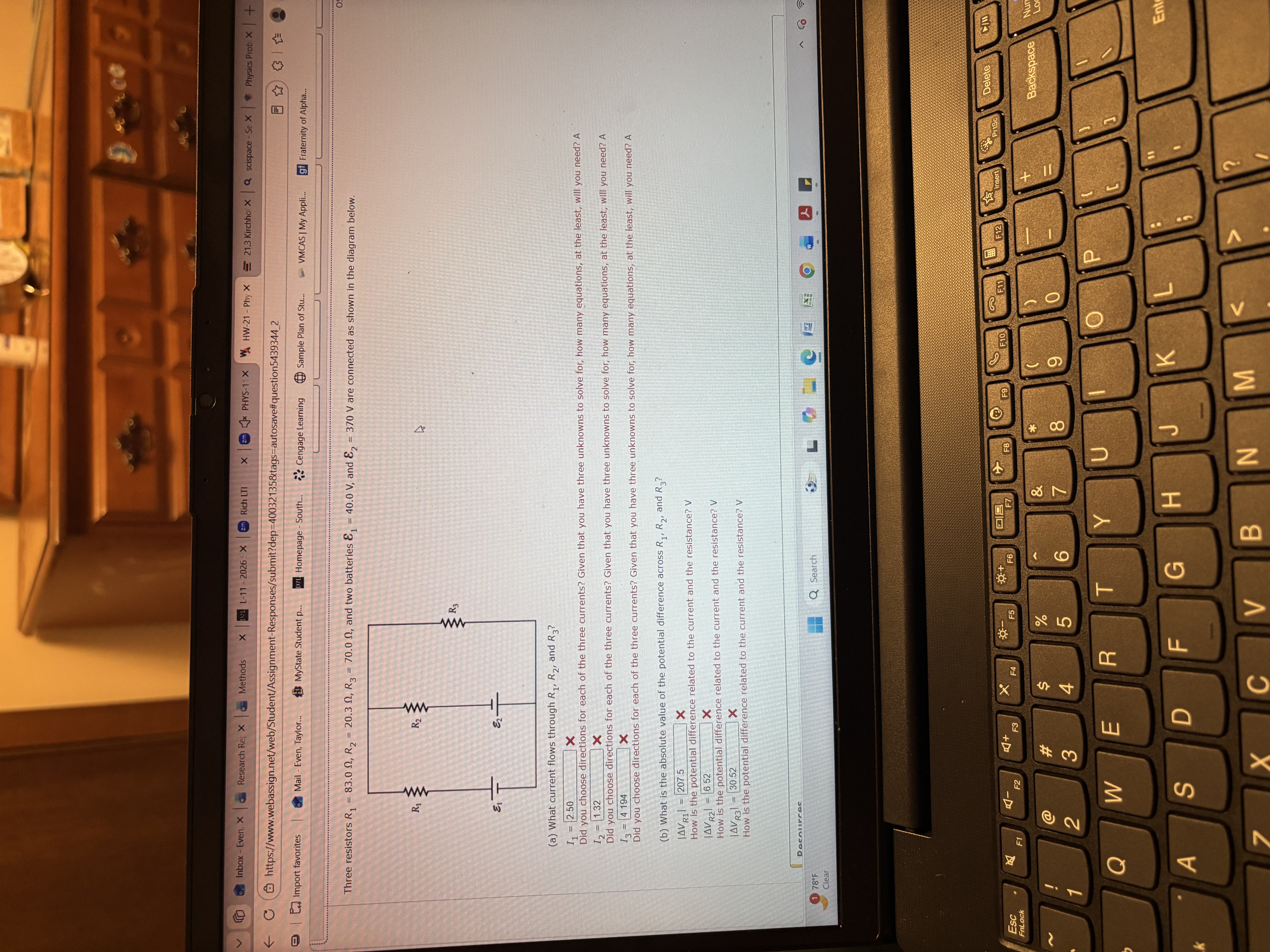
Yes, you must choose a direction for each of the three currents, and the choices can be arbitrary. With three unknown currents, you need at least three independent equations to solve for them (typically from Kirchhoff’s junction rule and loop rule).
What this question is really checking
When you analyze a multi-loop circuit, you first define unknown currents so you can write Kirchhoff equations consistently. The math does not require you to guess the “true” directions in advance.
Choosing current directions
Pick a direction (clockwise, left-to-right, etc.) for each of the three currents and stick with it in every equation.
- If a solved current comes out positive, your chosen direction was correct.
- If it comes out negative, the real current flows opposite your assumed direction.
How many equations you need for three unknown currents
You have three unknowns, so you need at least three independent equations.
In circuit problems, these usually come from:
- Kirchhoff’s Current Law (KCL) at a junction: algebraic sum of currents into a node is zero.
- Kirchhoff’s Voltage Law (KVL) around loops: algebraic sum of potential changes around a closed loop is zero.
A common setup for three currents is one KCL equation plus two KVL loop equations, giving three independent equations total.

- Parallel circuit diagram: 1 battery, 3 lights, switch
- Find Resistance from 9.000 V and 0.025 A
- Voltage Drop Across a 4.0 Ω Load at 3.0 A
- Current Drawn by a 230.0 V Dryer (9.2 Ω)
- Instrument to Measure Potential Difference (Voltage)
- Electric Field on the Axis of a Charged Ring
- Hammer vs Feather in Vacuum: Which Value Differs?
- 52T and 9T bike gear ratio: wheel turns per crank
Comments (0)
Please to leave a comment.