
In the source text "Civil Discourse in America: Living in a Society Where People Have Different Opinions," what does civility mean, and why is it considered the foundation of social interactions?
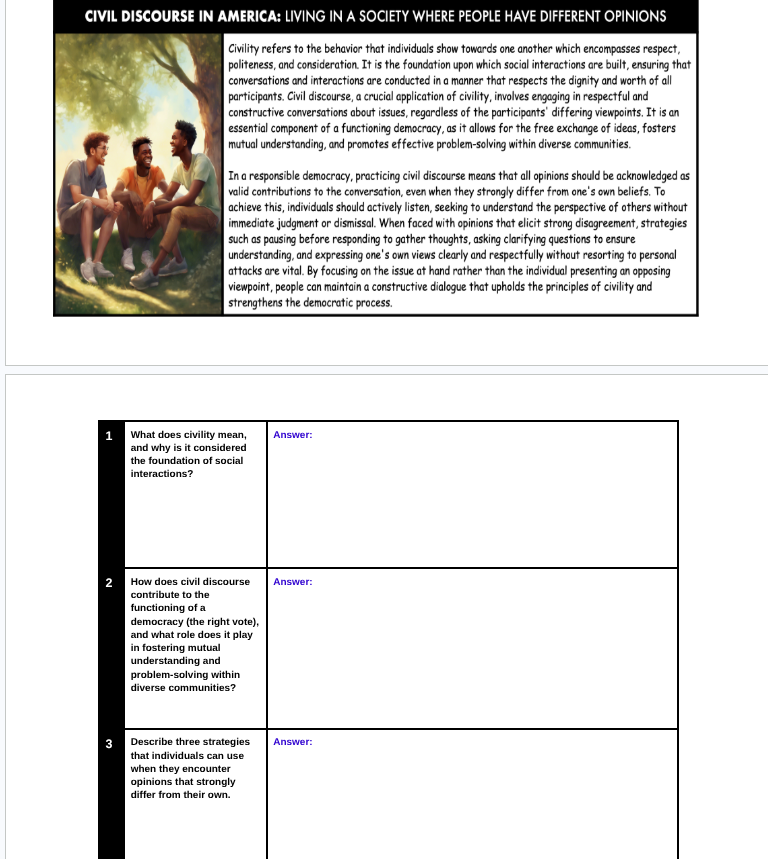
Civility refers to the behavior that individuals show towards one another which encompasses respect, politeness, and consideration. It is the foundation upon which social interactions are built, ensuring that conversations and interactions are conducted in a manner that respects the dignity and worth of all participants. Civil discourse, a crucial application of civility, involves engaging in respectful and constructive conversations about issues, regardless of the participants’ differing viewpoints. It is an essential component of a functioning democracy, as it allows for the free exchange of ideas, fosters mutual understanding, and promotes effective problem-solving within diverse communities.
In a responsible democracy, practicing civil discourse means that all opinions should be acknowledged as valid contributions to the conversation, even when they strongly differ from one’s own beliefs. To achieve this, individuals should actively listen, seeking to understand the perspective of others without immediate judgment or dismissal. When faced with opinions that elicit strong disagreement, strategies such as pausing before responding to gather thoughts, asking clarifying questions to ensure understanding, and expressing one’s own views clearly and respectfully without resorting to personal attacks are vital. By focusing on the issue at hand rather than the individual presenting an opposing viewpoint, people can maintain a constructive dialogue that upholds the principles of civility and strengthens the democratic process.
Civility means treating others with respect, politeness, and consideration, so that everyone’s dignity and worth are acknowledged in interaction. It is considered the foundation of social interactions because it sets the basic norms for how people speak and behave toward one another, making conversations safe, respectful, and constructive even when people disagree. Without civility, dialogue can shift into disrespect or personal attacks, which breaks down cooperation and understanding.
What the question is asking
You need to do two things from the source: (1) give the definition of civility, and (2) explain the role it plays in everyday interaction, meaning what it enables people to do together.
Meaning of "civility" in the source text
The passage defines civility as the behavior individuals show toward one another that includes:
- respect
- politeness
- consideration
So, civility is not just being “nice,” it is a set of behaviors that communicate that other people have value and deserve to be treated with dignity.
Why it is the "foundation" of social interactions
Calling civility the foundation means it is the base layer that supports everything else in social life. When people follow norms of respect and consideration, conversations can happen in a way that:
- protects everyone’s dignity
- keeps disagreement focused on issues rather than attacking people
- allows different viewpoints to be shared without shutting others down
That is why the text connects civility to civil discourse and democratic life: respectful interaction makes it possible to exchange ideas and solve problems in diverse communities.
Quick check: connect definition to impact
If civility is $\text{respect + politeness + consideration}$, then the outcome is more constructive conversation and less personal conflict. That is exactly what the passage means by “foundation.”

Comments (0)
Please to leave a comment.