
In the source text "Civil Discourse in America: Living in a Society Where People Have Different Opinions," how does civil discourse contribute to a functioning democracy, and how does it foster mutual understanding and problem-solving in diverse communities?
Civility refers to the behavior that individuals show towards one another which encompasses respect, politeness, and consideration. It is the foundation upon which social interactions are built, ensuring that conversations and interactions are conducted in a manner that respects the dignity and worth of all participants. Civil discourse, a crucial application of civility, involves engaging in respectful and constructive conversations about issues, regardless of the participants’ differing viewpoints. It is an essential component of a functioning democracy, as it allows for the free exchange of ideas, fosters mutual understanding, and promotes effective problem-solving within diverse communities.
In a responsible democracy, practicing civil discourse means that all opinions should be acknowledged as valid contributions to the conversation, even when they strongly differ from one’s own beliefs. To achieve this, individuals should actively listen, seeking to understand the perspective of others without immediate judgment or dismissal. When faced with opinions that elicit strong disagreement, strategies such as pausing before responding to gather thoughts, asking clarifying questions to ensure understanding, and expressing one’s own views clearly and respectfully without resorting to personal attacks are vital. By focusing on the issue at hand rather than the individual presenting an opposing viewpoint, people can maintain a constructive dialogue that upholds the principles of civility and strengthens the democratic process.
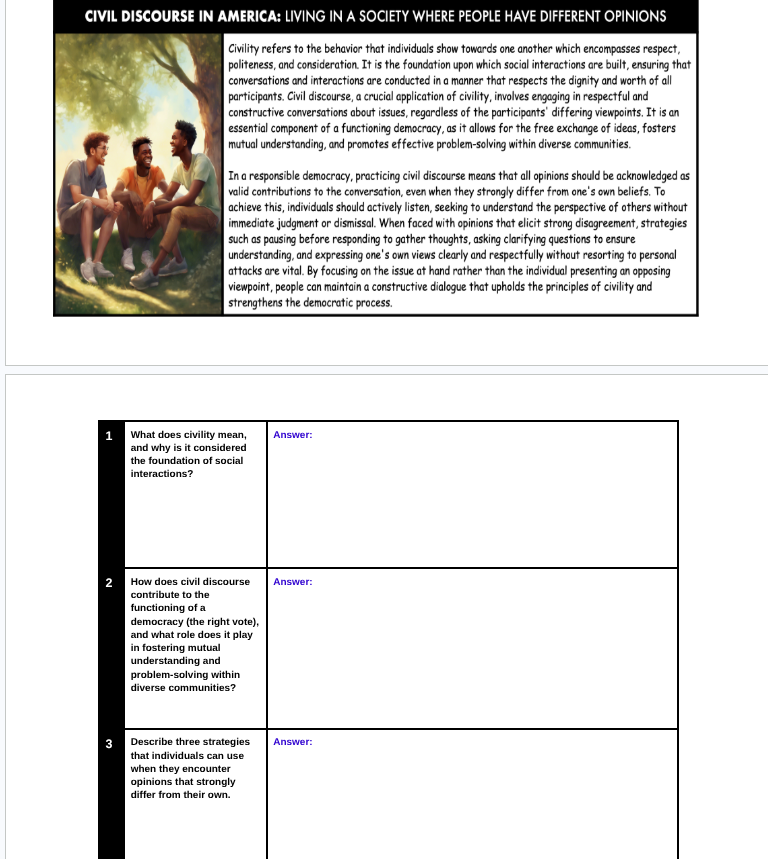
Civil discourse helps a democracy function because it protects the free exchange of ideas and keeps political participation, including voting, grounded in informed, respectful debate rather than intimidation or personal attacks. By treating different opinions as valid contributions and listening actively, people can understand why others think differently. That mutual understanding makes it easier to find common ground, clarify disagreements, and work toward practical solutions in diverse communities.
What the question is really asking
You need to connect the passage’s definition of civil discourse to three democratic outcomes: open participation (including voting), mutual understanding across differences, and better problem-solving.
Civil discourse and a functioning democracy
The text says civil discourse is “an essential component of a functioning democracy” because it allows for the free exchange of ideas. In practice, that means:
- People can share political views without being silenced by insults or threats.
- Citizens can weigh competing arguments, which supports informed choices when they vote.
- Disagreements stay focused on issues, which helps democratic institutions work instead of breaking down into hostility.
How it builds mutual understanding
The passage highlights active listening and “seeking to understand the perspective of others without immediate judgment.” Strategies like pausing before responding and asking clarifying questions reduce misinterpretation. When people feel heard and respected, they are more willing to explain their reasons and consider new information.
Why it improves problem-solving in diverse communities
Diverse communities contain conflicting experiences and priorities. Civil discourse helps groups solve problems because it:
- Keeps discussion centered on the issue, not on attacking the person.
- Makes it easier to identify shared goals (even when values differ).
- Encourages clearer, more respectful expression of views, which supports compromise and workable policies.
A quick example
If neighbors disagree about a school policy, civil discourse would mean asking clarifying questions, stating concerns without blaming individuals, and working toward a plan that addresses multiple needs rather than “winning” the argument.

Comments (0)
Please to leave a comment.