
Which statement best characterizes people’s attachments to political parties? A) Party attachments tend to be stable emotional and rational ties. B) Party attachments are fleeting, with very little stability over time. C) Party attachments change often, depending on the issues of the day. D) Party attachments will not change even when the issues evolve.
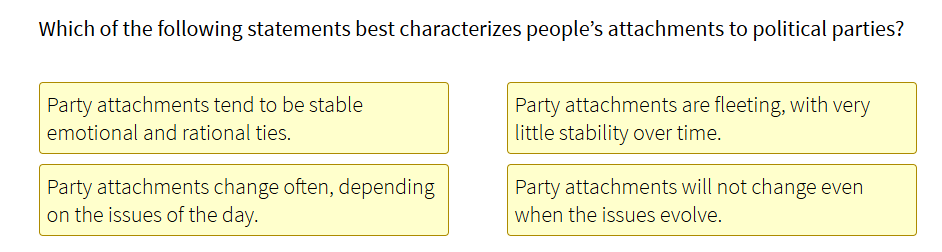
A) Party attachments tend to be stable emotional and rational ties. In political science, party identification is usually a long-term psychological attachment that changes slowly for most people, rather than shifting from issue to issue or never changing at all.
What this question is testing
You are being asked about the typical pattern of party identification over time: is it mostly stable, highly changeable, or completely fixed?
Why option A best fits what we observe
For many voters, attachment to a party works like a standing preference, shaped by social identity (family, community, group ties) and reinforced by experience. It often includes an emotional or identity component, plus some issue-based reasoning, so it is not purely irrational and it is not something that resets every news cycle.
Why the other choices are weaker
- B (fleeting, little stability): This describes a small slice of voters, but not the general pattern. Many people keep the same party identification for years.
- C (changes often with issues of the day): Short-term issue positions can move quickly, but party ID is typically more stable than day-to-day issue opinion.
- D (will not change even when issues evolve): Party attachments can change after major life events, long-term shifts in parties, or big political realignments, so they are not perfectly permanent.
A quick takeaway
A good summary is: party attachments are usually stable, but not unchangeable.

Comments (0)
Please to leave a comment.