
A fluid has a density of 921 kg/m³. At a depth of 1.22 m, the fluid pressure is 122,000 Pa. What is the pressure at the top (surface) of the fluid?
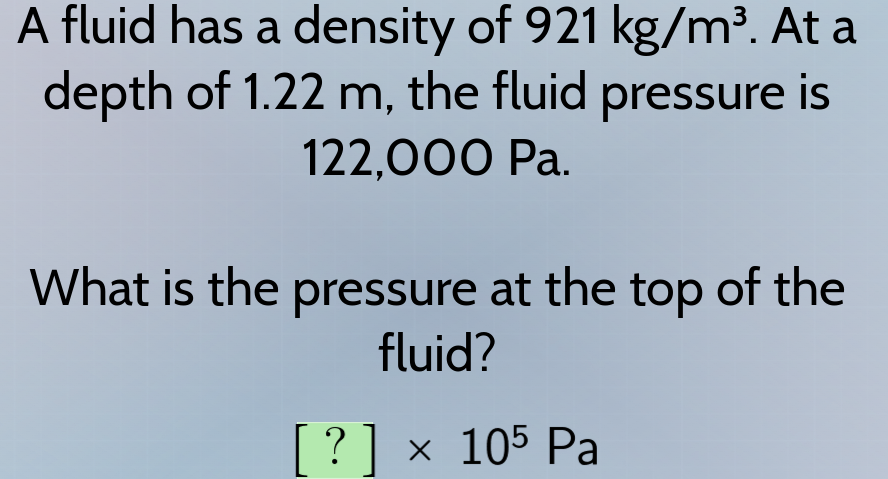
Use hydrostatic pressure: $P(h)=P_\text{top}+\rho g h$. So $P_\text{top}=122{,}000- (921)(9.81)(1.22)\approx 1.11\times 10^5\ \text{Pa}$. The pressure at the top is about $1.11\times 10^5$ Pa.
What the depth-pressure relation tells you
Pressure in a static fluid increases with depth because of the weight of the fluid above that point. So if you know the pressure at depth $h$, you can subtract the hydrostatic increase to get the surface (top) pressure.
Subtract the hydrostatic pressure increase
The model is: $$P(h)=P_\text{top}+\rho g h$$ Solve for the top pressure: $$P_\text{top}=P(h)-\rho g h$$ Substitute values: $$P_\text{top}=122{,}000-(921)(9.81)(1.22)$$ Compute the hydrostatic term: $$(921)(9.81)(1.22)\approx 11{,}023\ \text{Pa}$$ Now subtract: $$P_\text{top}\approx 122{,}000-11{,}023=110{,}977\ \text{Pa}$$
Write the result in $\times 10^5$ Pa form
$$110{,}977\ \text{Pa}\approx 1.11\times 10^5\ \text{Pa}$$

- Electric Field on the Axis of a Charged Ring
- Parallel circuit diagram: 1 battery, 3 lights, switch
- Hammer vs Feather in Vacuum: Which Value Differs?
- 52T and 9T bike gear ratio: wheel turns per crank
- Particles in Solids vs Gases Table Answers
- Angle of Refraction as the Dependent Variable
- Change in Temperature of Heated Copper Pipe
- Reazione vincolare con forza a 45° su piano liscio
Comments (0)
Please to leave a comment.