
Using the Solar System reference data, if a small planet orbited the Sun at 5 times Jupiter’s distance, what would its orbital period in Earth years?
The Solar System
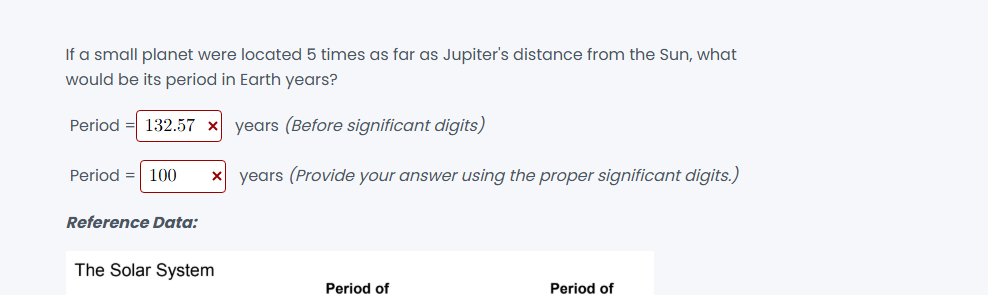
Using Kepler’s third law with distances in AU and periods in Earth years, $P^2=a^3$. Jupiter is about $5.2\,\text{AU}$ from the Sun, so $a=5\times 5.2=26\,\text{AU}$ and $P=\sqrt{26^3}=\sqrt{17576}\approx 132.6$ years. So the planet’s orbital period would be about $133$ Earth years.
What the problem is asking
You are scaling an orbit outward from Jupiter and then finding how much longer the planet takes to go around the Sun. The key idea is that orbital period grows quickly with distance.
Use Kepler’s third law in Earth units
For objects orbiting the Sun, if you measure:
- $a$ in astronomical units (AU)
- $P$ in Earth years
then Kepler’s third law is: $$P^2=a^3$$
Convert “5 times Jupiter’s distance” into AU
Jupiter’s average distance from the Sun is about $5.2\,\text{AU}$.
So the new planet’s orbital radius is: $$a=5\times 5.2=26\,\text{AU}$$
Compute the orbital period
Plug into $P=\sqrt{a^3}$: $$P=\sqrt{26^3}=\sqrt{17576}\approx 132.6$$
So the period is about $133$ Earth years.
Quick reasonableness check
Neptune orbits at about $30\,\text{AU}$ and takes about $165$ years, so a $26\,\text{AU}$ orbit being around $133$ years makes sense.

- Electric Field on the Axis of a Charged Ring
- Parallel circuit diagram: 1 battery, 3 lights, switch
- Hammer vs Feather in Vacuum: Which Value Differs?
- 52T and 9T bike gear ratio: wheel turns per crank
- Particles in Solids vs Gases Table Answers
- Angle of Refraction as the Dependent Variable
- Change in Temperature of Heated Copper Pipe
- Reazione vincolare con forza a 45° su piano liscio
Comments (0)
Please to leave a comment.