
A 5 kg block slides down a 3 m incline at 30° where the first 1 m is smooth and the next 2 m is roug
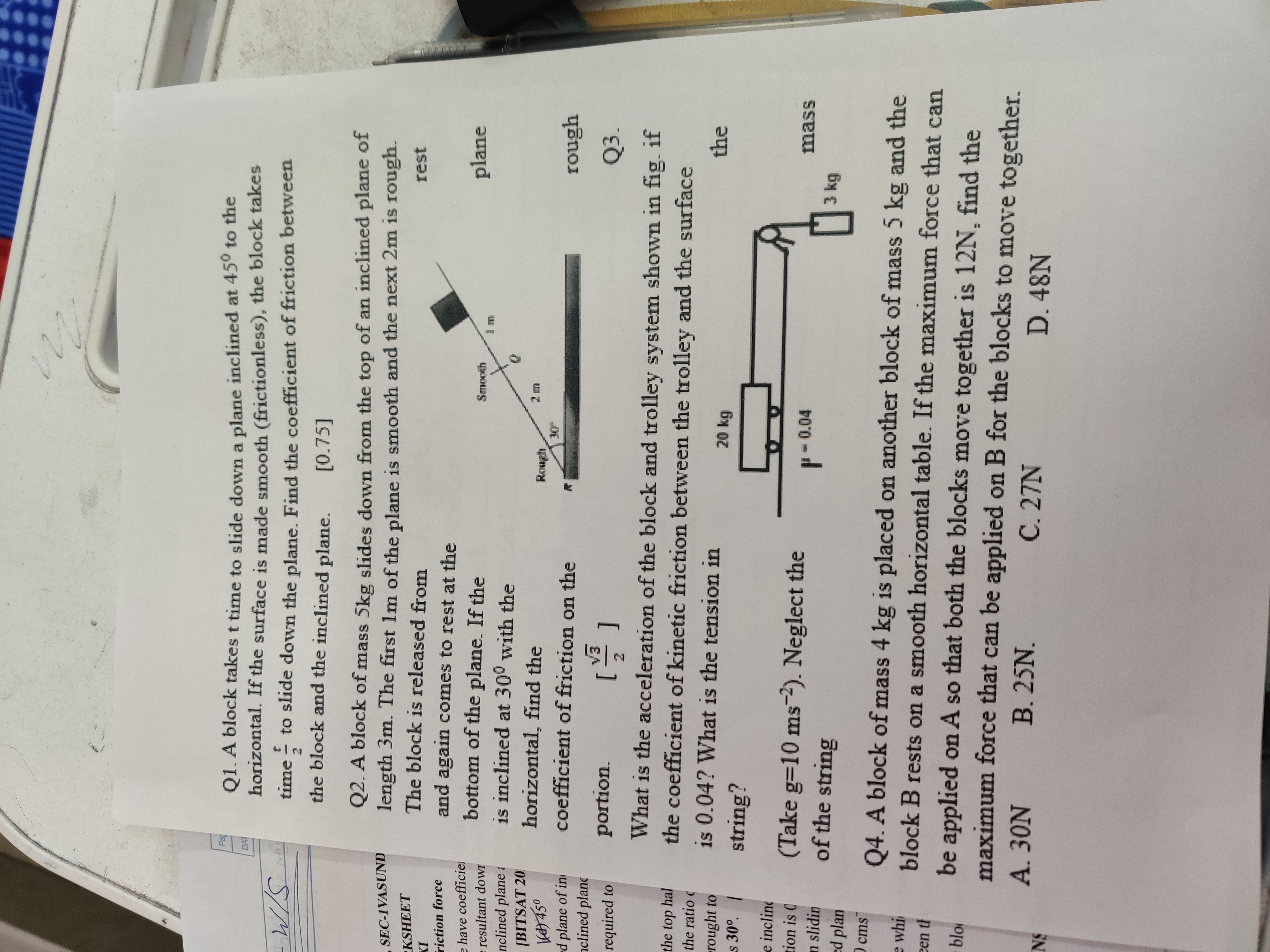
Since the block starts and ends at rest, the total loss in gravitational potential energy equals the work done by friction on the rough 2 m. The drop in height is $h = 3\sin 30^\circ = 1.5\,\text{m}$, so $mgh = 5g(1.5)=7.5g$. Friction work is $W_f = \mu (mg\cos 30^\circ)(2)$, so $\mu = \dfrac{7.5g}{2\cdot 5g\cos 30^\circ} = \dfrac{0.75}{\cos 30^\circ} \approx 0.866$.
What the “starts and ends at rest” detail tells you
If the block is released from rest and comes to rest again at the bottom, then the net change in kinetic energy is zero. So, any gravitational potential energy lost must be exactly dissipated by non-conservative work, here that is friction on the rough part (the smooth part does no friction work).
Gravitational potential energy lost over the whole incline
The vertical drop is the component of the 3 m length in the vertical direction:
$$h = 3\sin 30^\circ = 3\cdot \frac{1}{2} = 1.5\,\text{m}$$
So the decrease in gravitational potential energy is:
$$\Delta U = mgh = 5\cdot g \cdot 1.5 = 7.5g\,\text{J}$$
Work done by friction on only the rough section
Friction acts only on the rough 2 m.
Normal reaction on the incline is:
$$N = mg\cos 30^\circ$$
Friction force magnitude is $f = \mu N = \mu mg\cos 30^\circ$.
Work done by friction over 2 m is (opposes motion, so it removes energy):
$$W_f = \mu mg\cos 30^\circ \times 2$$
Equate energy lost to friction and solve for $\mu$
Because initial and final kinetic energies are both zero:
$$mgh = W_f$$
$$7.5g = \mu \,(5g\cos 30^\circ)\,2$$
Cancel $g$ and solve:
$$\mu = \frac{7.5}{10\cos 30^\circ} = \frac{0.75}{\cos 30^\circ} \approx \frac{0.75}{0.866} \approx 0.866$$
So the coefficient of friction on the rough portion is about $0.866$.

- Hammer vs Feather in Vacuum: Which Value Differs?
- 52T and 9T bike gear ratio: wheel turns per crank
- Reazione vincolare con forza a 45° su piano liscio
- Forca centripetale e automobilit (m=800 kg)
- Kinetic Energy From Mass, Distance, and Time
- Velocity After 2 Seconds of Free Fall (g = 9.8)
- How High Will a Student Swing After Grabbing a Rope?
- Roller Coaster Energy at A, B, C (No Friction)
Comments (0)
Please to leave a comment.