
For the spherical-coordinate region 1.0 m ≤ r ≤ 3.0 m, 0° ≤ θ ≤ 90°, and 0° ≤ ϕ ≤ 90°, (a) sketch/de
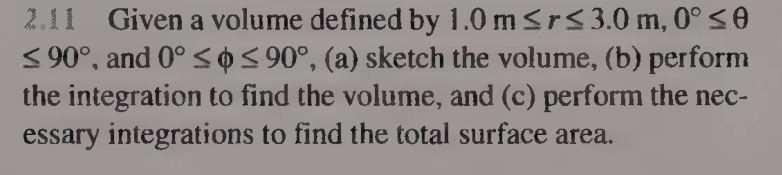
The region is the part of the spherical shell between radii 1 m and 3 m that lies in the first octant (bounded by the planes x = 0, y = 0, z = 0). Its volume is $$V=\int_{0}^{\pi/2}\int_{0}^{\pi/2}\int_{1}^{3} r^2\sin\theta\, dr\, d\theta\, d\phi=\frac{13\pi}{3}\;\text{m}^3.$$ The total surface area equals the octant areas of the two spheres plus the three quarter-annulus faces in the coordinate planes, giving $$A_{\text{total}}=\left(\frac{\pi}{2}3^2+\frac{\pi}{2}1^2\right)+3\left(\frac14\pi(3^2-1^2)\right)=11\pi\;\text{m}^2.$$
What this region looks like in 3D
Assume the standard spherical coordinates where $r$ is radius, $\theta$ is the polar angle from the positive $z$-axis, and $\phi$ is the azimuthal angle in the $xy$-plane.
- $1 \le r \le 3$ is a spherical shell (between two concentric spheres).
- $0 \le \theta \le \pi/2$ restricts you to $z \ge 0$ (above the $xy$-plane).
- $0 \le \phi \le \pi/2$ restricts you to $x \ge 0$ and $y \ge 0$.
So the volume is the first-octant wedge of the shell: bounded by $r=1$, $r=3$, and the planes $x=0$, $y=0$, $z=0$.
(b) Volume integral in spherical coordinates
The Jacobian for spherical coordinates is $$dV = r^2\sin\theta\, dr\, d\theta\, d\phi.$$ So $$V=\int_{\phi=0}^{\pi/2}\int_{\theta=0}^{\pi/2}\int_{r=1}^{3} r^2\sin\theta\, dr\, d\theta\, d\phi.$$ Compute each part:
Radial part: $$\int_{1}^{3} r^2\, dr = \left[\frac{r^3}{3}\right]_{1}^{3}=\frac{27-1}{3}=\frac{26}{3}.$$ Polar-angle part: $$\int_{0}^{\pi/2} \sin\theta\, d\theta = \left[-\cos\theta\right]_{0}^{\pi/2}=1.$$ Azimuth part: $$\int_{0}^{\pi/2} d\phi = \frac{\pi}{2}.$$ Multiply: $$V=\frac{26}{3}\cdot 1\cdot \frac{\pi}{2}=\frac{13\pi}{3}\ \text{m}^3.$$
(c) Total surface area: add the areas of all bounding faces
The boundary consists of:
- Outer spherical surface $r=3$
- Inner spherical surface $r=1$
- Plane $z=0$ (this corresponds to $\theta=\pi/2$)
- Plane $x=0$ (a constant-$\phi$ half-plane)
- Plane $y=0$ (a constant-$\phi$ half-plane)
Note: the bound $\theta=0$ collapses to the $+z$ axis (a curve), so it contributes zero area.
Spherical faces $r=\text{constant}$
On a sphere of radius $r$, the surface element is $$dA = r^2\sin\theta\, d\theta\, d\phi.$$ For $r=3$: $$A_{r=3}=\int_{0}^{\pi/2}\int_{0}^{\pi/2} 3^2\sin\theta\, d\theta\, d\phi =9\left(\int_{0}^{\pi/2}\sin\theta\, d\theta\right)\left(\int_{0}^{\pi/2} d\phi\right) =9\cdot 1\cdot \frac{\pi}{2}=\frac{9\pi}{2}.$$ For $r=1$: $$A_{r=1}=\int_{0}^{\pi/2}\int_{0}^{\pi/2} 1^2\sin\theta\, d\theta\, d\phi =1\cdot 1\cdot \frac{\pi}{2}=\frac{\pi}{2}.$$ So the spherical-area total is $$A_{\text{spheres}}=\frac{9\pi}{2}+\frac{\pi}{2}=5\pi.$$
Planar faces (three quarter-annuli)
Each coordinate plane cuts the shell in a quarter-annulus sector of angle $\pi/2$ with radii 1 and 3. In 2D polar coordinates on that plane, $dA=\rho\, d\rho\, d\alpha$.
Area of one quarter-annulus: $$A_{\text{one plane}}=\int_{\alpha=0}^{\pi/2}\int_{\rho=1}^{3} \rho\, d\rho\, d\alpha =\left(\int_{0}^{\pi/2} d\alpha\right)\left(\int_{1}^{3} \rho\, d\rho\right) =\frac{\pi}{2}\cdot \left[\frac{\rho^2}{2}\right]_{1}^{3} =\frac{\pi}{2}\cdot \frac{9-1}{2}=2\pi.$$ There are three such planes ($x=0$, $y=0$, $z=0$), so $$A_{\text{planes}}=3(2\pi)=6\pi.$$
Total surface area
$$A_{\text{total}}=A_{\text{spheres}}+A_{\text{planes}}=5\pi+6\pi=11\pi\ \text{m}^2.$$

- Incenter Angle Bisector Problem: Find m∠BCP
- Type of Data: Water Intake (L/day) From Cows
- Evaluate $h(-1)$ for $h(x)=-5x^3+x+2$
- Probability a Batch Is Accepted (3 Tested, 0 Failures)
- Conditional Probability From a Gender-Carrier Table
- AA Similarity Proof for △EFG ∼ △EHI
- Percentage and Cumulative Percentages for Water Intake
- Plot car value graph: £500 loses £80 per month
Comments (0)
Please to leave a comment.