
For the reaction 2H₂O → 2H₂ + O₂, what is the energy released by forming the product bonds using the bond energies H-H = 436 kJ/mol and O=O = 498 kJ/mol?
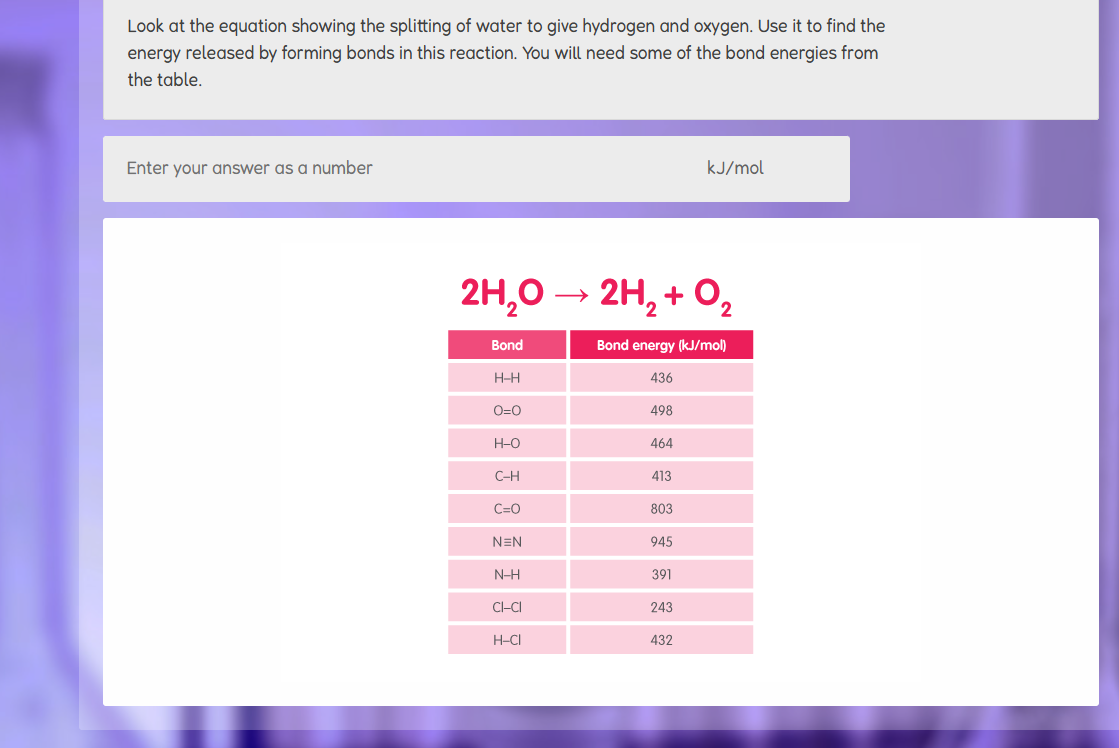
The bonds formed are two H-H bonds (in 2H₂) and one O=O bond (in O₂). The energy released by bond formation is $2(436) + 498 = 1370$ kJ/mol for the reaction as written.
What “energy released by forming bonds” means
Bond formation releases energy. So you only add up the bond energies of the new bonds that appear in the products.
Count the bonds in the products
From the equation $2H_2O \rightarrow 2H_2 + O_2$:
- $2H_2$ contains $2$ H-H bonds total (each $H_2$ molecule has one H-H bond)
- $O_2$ contains $1$ O=O bond
Add the bond energies for the bonds formed
Using the table values:
- H-H: $436\ \text{kJ/mol}$
- O=O: $498\ \text{kJ/mol}$
Total energy released by forming product bonds: $$2(436) + 498 = 872 + 498 = 1370\ \text{kJ/mol}$$
Final check
You used only product bonds (formed bonds), so the result is a positive energy release value: $1370\ \text{kJ/mol}$ for the reaction as written.

- Carbon-14 Remaining After 11,500 Years (Half-Life 5730)
- How many electrons are in an N3− ion?
- How Many Electrons Are in a Lithium Ion (Li+)?
- Distance Between Neon Atoms When Heated
- Metal Liquid at Room Temperature Used in Thermometers
- How to Tell If HCl Reacts With Metals in Containers
- Period, Group (Family), Atomic Radius, and Ion
- One Gallon of Gas Makes About 20 lb CO₂: True/False
Comments (0)
Please to leave a comment.