
What are two mechanisms by which the body responds to an increase in body temperature?
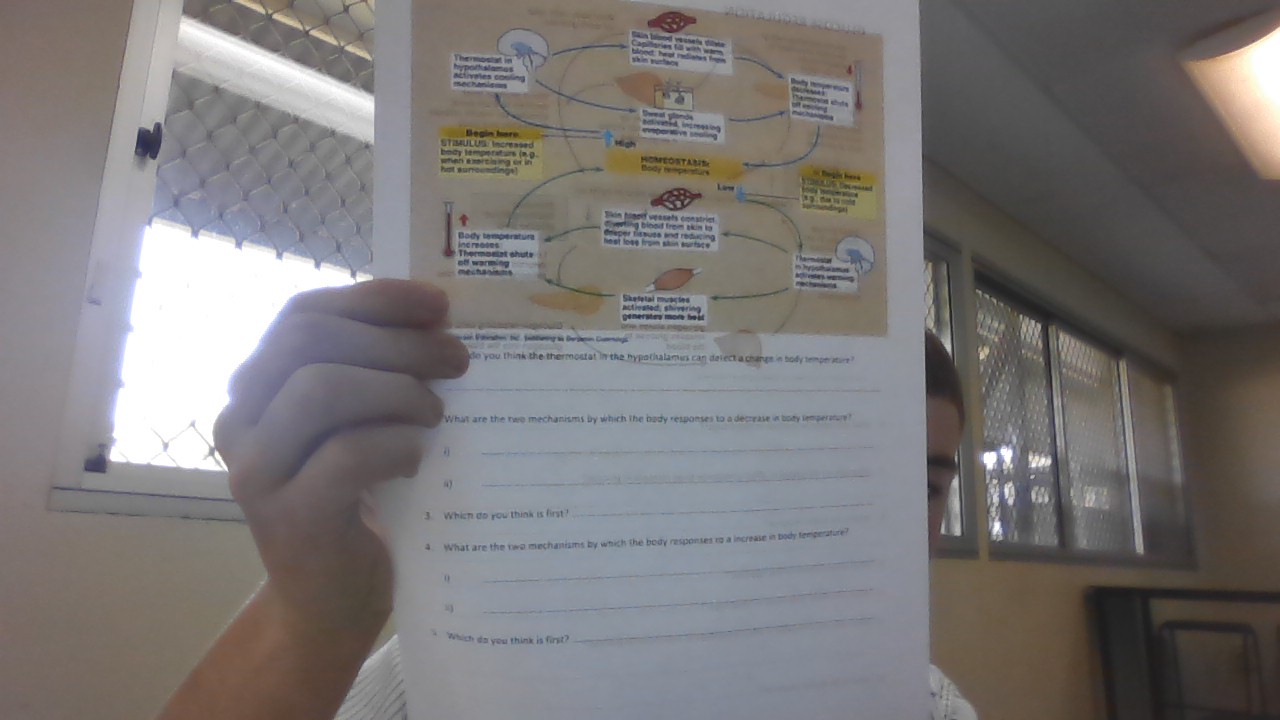
The body responds to increased body temperature mainly by (a) sweating (evaporative cooling) and (b) vasodilation of skin blood vessels, which increases blood flow to the skin and heat loss.
What this question is asking
You need two normal thermoregulation responses the body uses to lose heat when core temperature rises above the set point.
Mechanism 1: Sweating (evaporative cooling)
Sweat glands secrete sweat onto the skin surface. As the water in sweat evaporates, it absorbs heat energy from the skin, which cools the body.
Mechanism 2: Vasodilation in the skin (increasing heat transfer)
Arterioles in the skin widen (vasodilation), sending more warm blood from the core to the skin surface. This increases heat loss to the environment by radiation and convection.
Quick way to remember
Hot body: "open the vessels" (vasodilation) and "make sweat" (evaporation) to dump heat.

- Maximal Cardiac Output After Aerobic Training
- Type AB Blood Transfusion: Can AB Receive A, B, or O?
- Venous End of Pulmonary Capillary From $p_{a}O_2$
- Function of the Cardiovascular System Explained
- Carbon Monoxide (CO) Effect: Blocks Oxygen Transport
- Peristalsis in the Digestive System Definition
- Cold Response Mechanisms: Shivering and Vasoconstriction
- British Gene Therapy Survey: Three Key Concerns
Comments (0)
Please to leave a comment.