
What are two mechanisms by which the human body responds to a decrease in body temperature?
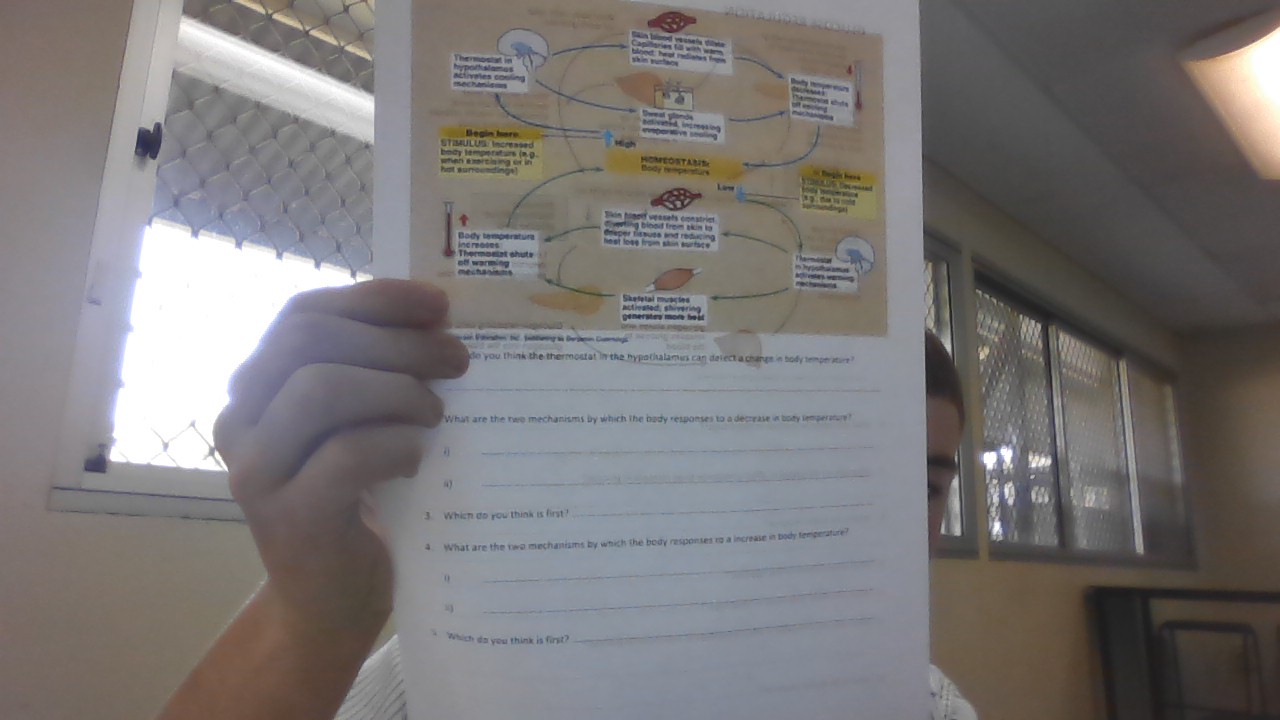
Two main responses to falling body temperature are: (a) vasoconstriction of skin blood vessels to reduce heat loss, and (b) shivering (involuntary muscle contractions) to generate heat by increasing metabolism.
What the question is asking
When your core temperature drops, your body tries to (1) lose less heat to the environment and (2) make more heat inside the body. You only need two examples of these thermoregulation responses.
Mechanism 1: Reduce heat loss (vasoconstriction)
Cold is detected by thermoreceptors and processed by the hypothalamus. The sympathetic nervous system causes arterioles in the skin to constrict.
- Less warm blood reaches the skin surface.
- Heat transfer to the air decreases, so the core temperature is protected.
Mechanism 2: Increase heat production (shivering)
If conserving heat is not enough, the hypothalamus triggers shivering.
- Skeletal muscles contract rapidly and involuntarily.
- These contractions increase cellular respiration and ATP use.
- A large fraction of that energy is released as heat, raising body temperature.
Quick way to remember
Cold response = "save heat" (vasoconstriction) + "make heat" (shivering).

- Maximal Cardiac Output After Aerobic Training
- Type AB Blood Transfusion: Can AB Receive A, B, or O?
- Venous End of Pulmonary Capillary From $p_{a}O_2$
- Function of the Cardiovascular System Explained
- Carbon Monoxide (CO) Effect: Blocks Oxygen Transport
- Peristalsis in the Digestive System Definition
- Responses to Increased Body Temperature (2 Mechanisms)
- British Gene Therapy Survey: Three Key Concerns
Comments (0)
Please to leave a comment.