
Fill in the blanks using the word bank (atom, atomic number, electrons, neutrons, protons) about atomic structure and the Periodic Table: The smallest part of an element that still has the properties of the element is an (4) ____. There are negatively charged (5) ____ in a cloud around the atom. The nucleus contains positively charged (6) ____ and (7) ____ with no charge. Elements are identified by the number of protons, or the (8) ____ of the element.
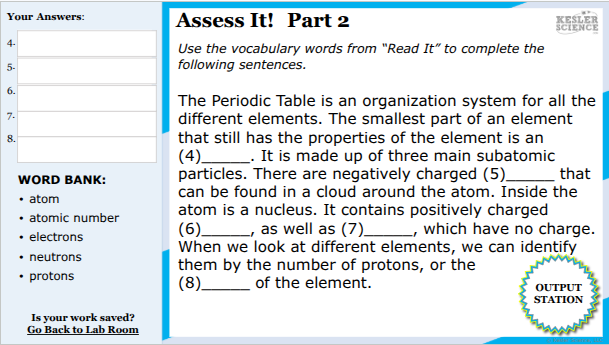
(4) atom, (5) electrons, (6) protons, (7) neutrons, (8) atomic number. An atom is the smallest unit of an element, electrons are negative and found around the nucleus, protons are positive in the nucleus, and neutrons are neutral. The atomic number equals the number of protons and identifies the element.
What you are matching in each blank
Each blank is a clue about either (1) what an element is made of, (2) the charges of subatomic particles, or (3) the property that identifies an element on the Periodic Table.
Blank (4): the smallest part of an element
The smallest part of an element that still keeps the element’s properties is an atom.
So (4) = atom.
Blanks (5), (6), (7): particles and their charges
- Negatively charged particles in a cloud around the atom are electrons.
- Positively charged particles in the nucleus are protons.
- Particles in the nucleus with no charge are neutrons.
So:
- (5) = electrons
- (6) = protons
- (7) = neutrons
Blank (8): how elements are identified
An element is defined by its number of protons. The number of protons is called the atomic number.
So (8) = atomic number.
Quick check
If you read the paragraph with the filled words, the charges and locations all line up with standard atomic structure: electrons (negative) outside, protons (positive) and neutrons (neutral) in the nucleus, and atomic number equals protons.

- How many electrons are in an N3− ion?
- How Many Electrons Are in a Lithium Ion (Li+)?
- Rutherford Gold Foil Experiment: Positive Charge Location
- Carbon-14 Remaining After 11,500 Years (Half-Life 5730)
- Distance Between Neon Atoms When Heated
- Metal Liquid at Room Temperature Used in Thermometers
- Period, Group (Family), Atomic Radius, and Ion
- One Gallon of Gas Makes About 20 lb CO₂: True/False
Comments (0)
Please to leave a comment.