
A small square loop of wire of side l is placed inside a large square loop of side L (L >> l). If the loops are coplanar and their centres coincide, what is the mutual inductance directly proportional to? A) L/l B) l/L C) L^2/l D) l^2/L
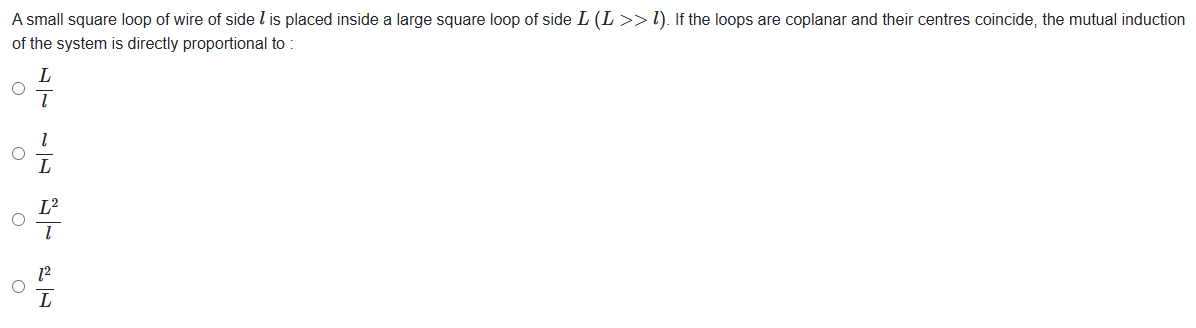
The mutual inductance scales as $M \propto \dfrac{l^2}{L}$, so the correct choice is D. For $L \gg l$, the magnetic field produced by the large loop is nearly uniform over the small loop and has magnitude $B \propto I/L$ near the center, giving flux $\Phi \approx B\, l^2 \propto (I/L)l^2$ and hence $M=\Phi/I \propto l^2/L$.
What we are comparing when $L \gg l$
Mutual inductance is $$M=\frac{\Phi}{I},$$ where $\Phi$ is the magnetic flux through the small loop due to current $I$ in the large loop. Since $L \gg l$, the field from the large loop does not change much across the area of the small loop, so we can treat it as roughly constant over that small area.
Magnetic field of the large square near its center
At the center of a square loop of side $L$, the distance to each side is $r=L/2$. The field from one finite straight side scales like $$B_{\text{side}} \propto \frac{\mu_0 I}{r} \propto \frac{\mu_0 I}{L}.$$ All four sides contribute with the same scaling, so the total field at the center still scales as $$B_{\text{center}} \propto \frac{\mu_0 I}{L}.$$ (Only the numerical constant changes when you add the four sides.)
Flux through the small loop and the scaling of $M$
The small loop area is $A=l^2$. With nearly uniform $B$ over the small loop, $$\Phi \approx B_{\text{center}}\, A \propto \left(\frac{I}{L}\right) l^2.$$ Therefore, $$M=\frac{\Phi}{I} \propto \frac{l^2}{L}.$$
Correct option
So the mutual inductance is directly proportional to $\dfrac{l^2}{L}$, which is option D.

- EM Wave Direction and Electric Field from $B_x(y,t)$
- Is 1 Wb/m² Equal to 1 Tesla (T)?
- Magnetic Force and Electric Field Between Two Wires
- Electric Field on the Axis of a Charged Ring
- Parallel circuit diagram: 1 battery, 3 lights, switch
- Hammer vs Feather in Vacuum: Which Value Differs?
- Particles in Solids vs Gases Table Answers
- 52T and 9T bike gear ratio: wheel turns per crank
Comments (0)
Please to leave a comment.