
In the Guided Problem Solving Problem 3 series circuit with a 9 V source and resistors $R_1 = 3\,k\Omega$ (points 1-2), $R_2 = 10\,k\Omega$ (points 2-3), and $R_3 = 5\,k\Omega$ (points 3-4), what are (a) total resistance, (b) total current, (c) each resistor current, and (d) each resistor voltage?
Problem 3: See the illustration below for the circuit.
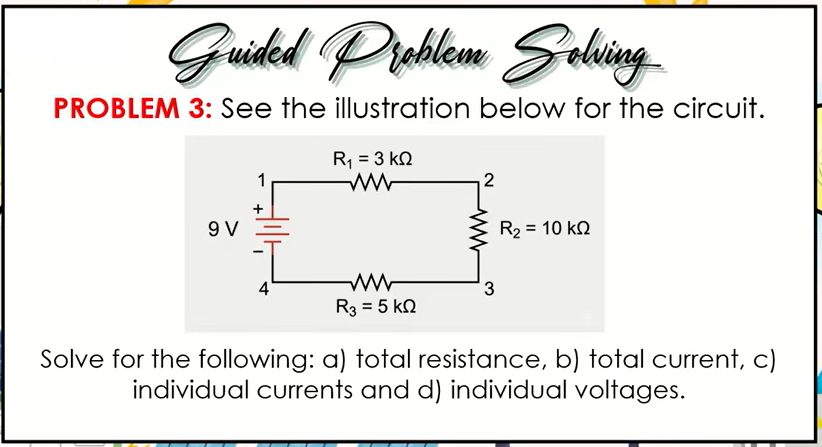
Circuit illustration:
- 9 V source between points 1 and 4
- Resistor R1 = 3 kΩ between points 1 and 2
- Resistor R2 = 10 kΩ between points 2 and 3
- Resistor R3 = 5 kΩ between points 3 and 4
Because the resistors are in series, the total resistance is $R_T = 3\, k\Omega + 10\, k\Omega + 5\, k\Omega = 18\, k\Omega$. The total current is $I_T = V/R_T = 9\, V / 18\, k\Omega = 0.5\, mA$. In a series circuit the current is the same everywhere, so $I_1 = I_2 = I_3 = 0.5\, mA$. The voltage drops are $V_1 = 1.5\, V$, $V_2 = 5.0\, V$, and $V_3 = 2.5\, V$ (they add to $9\, V$).
What the circuit setup tells you
All three resistors ($R_1$, $R_2$, $R_3$) are connected end-to-end from point 1 to point 4, with a $9\, V$ source across points 1 and 4. That is a series circuit, so:
- Resistances add directly.
- The same current flows through every resistor.
- Individual voltage drops add up to the source voltage.
(a) Total resistance for series resistors
For series resistors: $$ R_T = R_1 + R_2 + R_3 $$ Substitute values: $$ R_T = 3\, k\Omega + 10\, k\Omega + 5\, k\Omega = 18\, k\Omega $$
(b) Total current from Ohm's law
Use $I = V/R$ with the source voltage across the total resistance: $$ I_T = \frac{V}{R_T} = \frac{9\, V}{18\,000\,\Omega} = 0.0005\, A = 0.5\, mA $$
(c) Individual currents in a series circuit
In series, there is only one path for current, so: $$ I_1 = I_2 = I_3 = I_T = 0.5\, mA $$
(d) Voltage drops across each resistor
Compute each drop with $V_n = I\, R_n$ (using $I = 0.5\, mA$):
-
Across $R_1 = 3\, k\Omega$: $$ V_1 = (0.5\, mA)(3\, k\Omega) = 1.5\, V $$
-
Across $R_2 = 10\, k\Omega$: $$ V_2 = (0.5\, mA)(10\, k\Omega) = 5.0\, V $$
-
Across $R_3 = 5\, k\Omega$: $$ V_3 = (0.5\, mA)(5\, k\Omega) = 2.5\, V $$
Quick check (Kirchhoff’s Voltage Law for a series loop): $$ V_1 + V_2 + V_3 = 1.5 + 5.0 + 2.5 = 9.0\, V $$ The drops sum to the source voltage, so the results are consistent.

Comments (0)
Please to leave a comment.