
Which three statements do NOT describe how observations from the fossil record support how organisms change over time? A) Hard parts of animals, such as bones and teeth, are much more likely to become fossilized than other parts made of soft tissue. B) The fossil record consists of links that provide evidence that some groups have a shared history, such as the shared history between fish and reptiles or reptiles and birds. C) The fossil record has many more examples of organisms that lived in water where their remains were more likely to be buried quickly. D) The fossils that are found in rock layers of different ages are related to but different from fossils that are found in rock layers above and below. E) Close examination of fossils can reveal details about the diet, environment, and even behaviors of the organisms that the fossils represent.
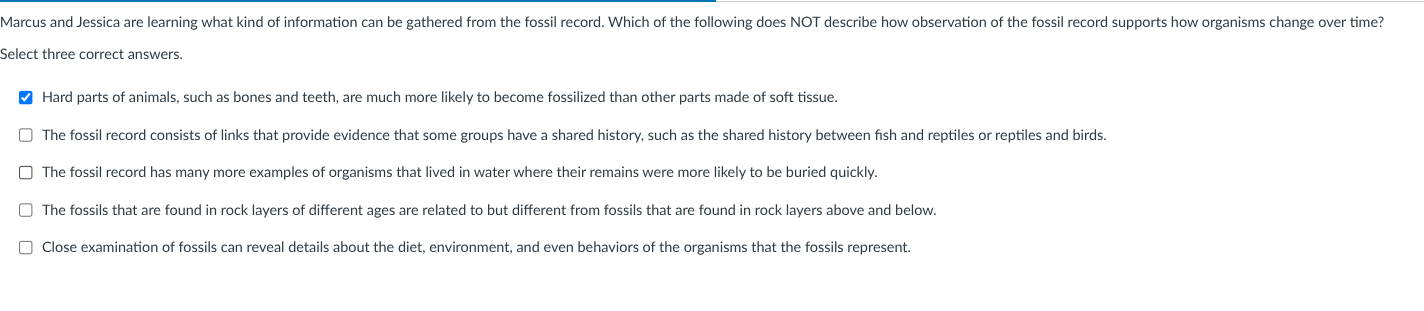
The three statements that do NOT describe evidence from the fossil record for organisms changing over time are A, C, and E. A and C describe fossilization bias (what is more likely to fossilize and where fossils are more common), not evolutionary change. E describes what details fossils can reveal about an organism’s life, but it does not directly describe patterns showing change through time the way B and D do.
What the question is really asking
You are looking for choices that do not describe fossils as evidence of evolutionary change over time (such as shared ancestry, transitional forms, or a sequence of related forms in older to younger rock layers). Some options instead describe how fossils form or what kinds of fossils we tend to find.
Options that DO support change over time (so they are NOT selected)
- B: Mentions "links" and shared history between major groups. That is describing common ancestry and transitional relationships, which is evolutionary evidence.
- D: Describes a pattern across rock layers of different ages: fossils are related but different above and below. This is exactly the expected pattern if lineages change gradually through time.
Why A, C, and E do NOT describe evolutionary change evidence
- A: Says hard parts fossilize more than soft tissue. This explains preservation bias in the fossil record, not how organisms change.
- C: Says more fossils come from water environments because burial is more likely. This is another sampling/preservation bias, not direct evidence of evolutionary change.
- E: Fossils can show diet, environment, and behavior. That gives information about an organism’s biology, but it does not itself describe the key time-pattern evidence (succession through layers, related forms changing, or transitional links).
Final selection
The three answers that do NOT describe fossil-record support for change over time are A, C, and E.

- Convergent Evolution Example: Anteaters on 3 Continents
- British Gene Therapy Survey: Three Key Concerns
- Maximal Cardiac Output After Aerobic Training
- What Induces Multicellularity in Choanoflagellates?
- Marine Food Web Classification: Producer to Carnivore
- Order the Statements: Bird Beaks and Seed Size
- Gas Released During Photosynthesis in Pondweed
- Skin cell vs bacterial cell: how many times longer?
Comments (0)
Please to leave a comment.