
Why is stratospheric ozone considered “good” while tropospheric ozone is considered “bad” ozone?
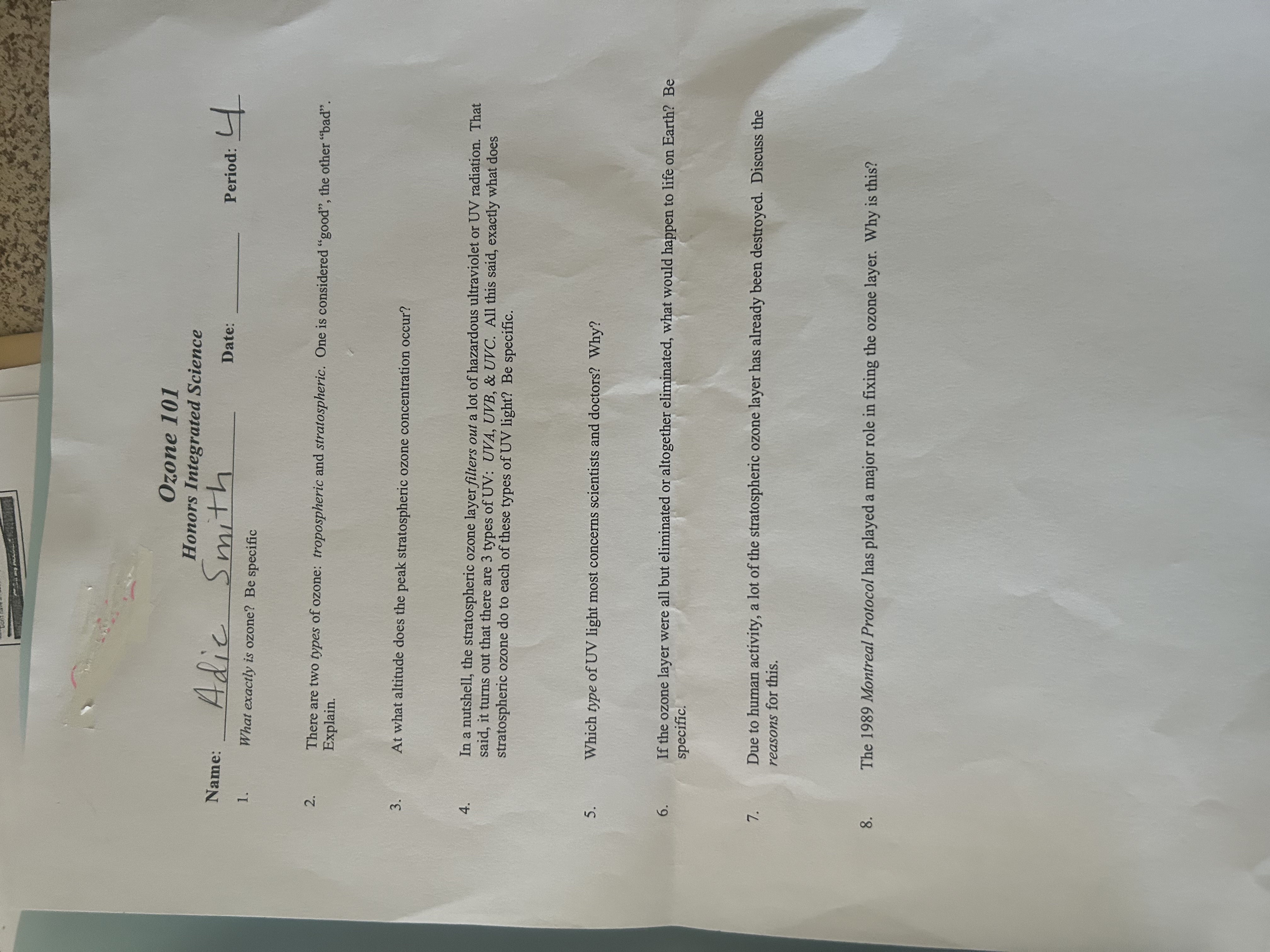
Stratospheric ozone is considered “good” because it forms the ozone layer high in the atmosphere, which absorbs much of the Sun’s harmful ultraviolet (UV) radiation and protects life on Earth. Tropospheric ozone is considered “bad” because it is a ground-level air pollutant formed from reactions of $NO_x$ and VOCs in sunlight, and it harms human lungs, damages plants, and contributes to smog.
What “good” vs “bad” ozone is really about
Ozone is the same molecule, $O_3$, in both cases. The difference is where it is in the atmosphere and what effects it has there.
Stratospheric ozone, what it does for you
In the stratosphere (roughly 10–50 km up), ozone forms a layer that absorbs UV-B and UV-C radiation.
- This reduces UV exposure at Earth’s surface.
- Less UV means lower risk of skin cancer and cataracts, and less damage to ecosystems. So in the stratosphere, ozone is protective, which is why it is called “good.”
Tropospheric (ground-level) ozone, how it forms
In the troposphere (the air we breathe), ozone is mainly produced as a secondary pollutant when sunlight drives reactions involving nitrogen oxides and volatile organic compounds:
- Precursors: $NO_x$ (from vehicles, power plants) and VOCs (from fuels, solvents, some natural sources).
- Sunlight helps convert these into $O_3$. This is why ozone pollution is often worse on hot, sunny days.
Why ground-level ozone is harmful
Tropospheric ozone is a strong oxidant.
- Human health: irritates airways, worsens asthma, reduces lung function.
- Environment: damages leaf tissue, reduces crop yields and forest growth.
- Air quality: a major component of photochemical smog. So in the troposphere, ozone acts as a pollutant, which is why it is called “bad.”
Quick summary
Same molecule ($O_3$), different location:
- Stratosphere: blocks harmful UV, beneficial.
- Troposphere: pollutant that harms lungs and plants.

- Why It Feels Sticky in Summer, Relative Humidity
- Is a rock’s streak the same color as the rock?
- Upwelling Process in the Ocean (Deep Cold Water)
- Water Vapour Cools Overnight and Forms Dew: Condense
- Ideal vs Not Ideal Index Fossil Criteria (Examples)
- Can compacted sand form a rock (sandstone)?
- Sedimentary Rock Layers With Fossils (Multiple Choice)
- Greenhouse Effect: Good, Bad, or Both? (A–C)
Comments (0)
Please to leave a comment.