
A student has a 1 g sample of each of the following compounds: NaCl, KBr, and KCl. Which list shows the samples in order of increasing number of moles? A) NaCl < KCl < KBr B) NaCl < KBr < KCl C) KCl < NaCl < KBr D) KBr < KCl < NaCl
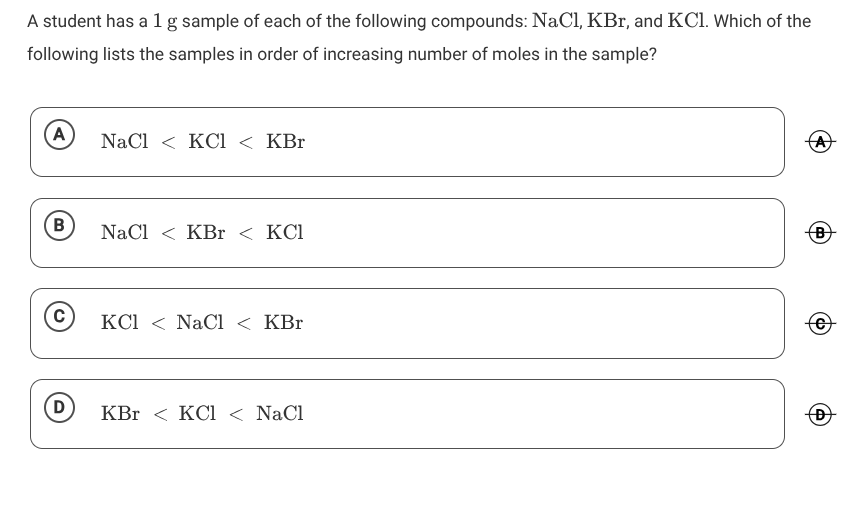
D) KBr < KCl < NaCl. For equal masses, the number of moles is $n = \frac{m}{M}$, so the sample with the largest molar mass has the fewest moles. Since $M(\mathrm{KBr}) \approx 119.0\,\mathrm{g/mol} > M(\mathrm{KCl}) \approx 74.6\,\mathrm{g/mol} > M(\mathrm{NaCl}) \approx 58.4\,\mathrm{g/mol}$, the moles increase in the order KBr, then KCl, then NaCl.
What decides “more moles” when the mass is the same?
All three samples have the same mass (1 g). Moles depend on molar mass: $$n = \frac{m}{M}$$ So if $m$ is fixed, a smaller $M$ means a larger number of moles.
Compare molar masses of NaCl, KCl, and KBr
Use approximate atomic masses (g/mol): $\mathrm{Na}=22.99$, $\mathrm{K}=39.10$, $\mathrm{Cl}=35.45$, $\mathrm{Br}=79.90$.
- $$M(\mathrm{NaCl}) = 22.99 + 35.45 = 58.44\,\mathrm{g/mol}$$
- $$M(\mathrm{KCl}) = 39.10 + 35.45 = 74.55\,\mathrm{g/mol}$$
- $$M(\mathrm{KBr}) = 39.10 + 79.90 = 119.00\,\mathrm{g/mol}$$
Turn molar mass into an order of moles
Because $n = \frac{1\,\mathrm{g}}{M}$:
- Largest $M$ gives smallest $n$, so $\mathrm{KBr}$ has the fewest moles.
- Next is $\mathrm{KCl}$.
- Smallest $M$ gives largest $n$, so $\mathrm{NaCl}$ has the most moles.
Therefore, increasing moles: $$\mathrm{KBr} < \mathrm{KCl} < \mathrm{NaCl}$$ That matches choice D.

- One Gallon of Gas Makes About 20 lb CO₂: True/False
- Grams of NaOH and LiOH to Remove 288 g CO₂
- Balance Li + HNO3 → LiNO3 + H2 Equation
- Balanced Chemical Equations (P, Mg, HgO, Al₂O₃)
- Balance NH3 + H2SO4 → (NH4)2SO4 Equation
- Balance NH3 + H2SO4 → (NH4)2SO4
- Relative Molecular Mass (Mr) of Common Compounds
- Molecules in 10.32 Moles of H2O (Water)
Comments (0)
Please to leave a comment.