
In Reading #2 “China’s side part 2,” how does the text justify China’s annexation of Tibet based on the Yuan dynasty, Genghis Khan, Kublai Khan, and the cho-yon relationship?
The actual “incorporation” of Tibet into China is strangely attributed to Genghis Khan and his later successor, Kublai Khan. Strangely, because Genghis Khan and Kublai Khan were not Chinese but Mongolian, and the dynasty they established – the Yuan – incorporated not only China but, for a brief period, the largest empire the world has ever seen. Moreover, the Mongolian Khans turned their legitimacy not to the Chinese past but to the Buddhist universal emperors of Tibet and India. To be sure, the cho-yon relationship, whereby the Mongolian prince protected the Tibetan lama and his teachings in return for the lama’s ministering to the religious needs of the Mongolian patron, began during this period and would later become the basis of the relationship between Tibet and China under the Manchu dynasty. But the fundamental relationship of Tibet during the Yuan dynasty, and for centuries thereafter, was with the Mongols rather than the Chinese.
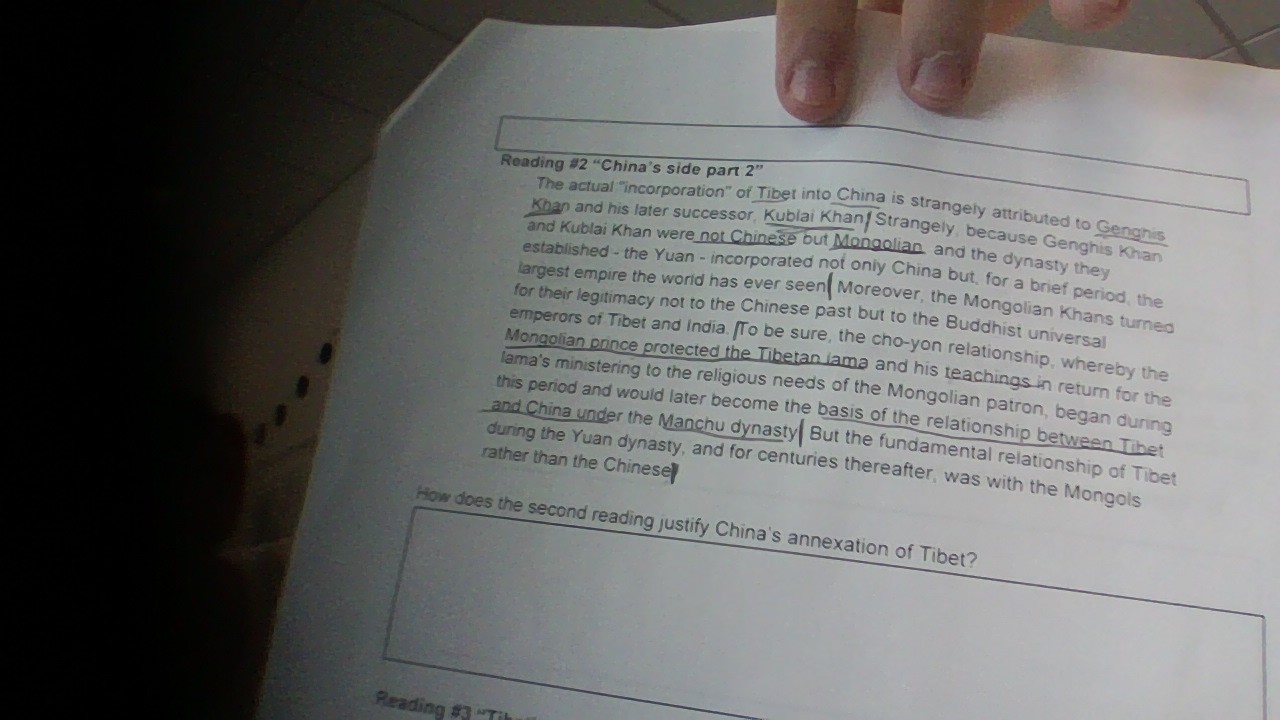
Reading #2 justifies China’s annexation of Tibet by tracing “incorporation” back to the Yuan dynasty under Genghis Khan and Kublai Khan and treating that imperial precedent as a basis for China’s later claim. It also points to the cho-yon (patron-priest) relationship that began in the Mongol period and later became a model for Tibet’s relationship with rulers of China under the Manchu dynasty. In other words, it frames Tibet’s status as historically tied to regimes that ruled China, even though the passage itself notes this is “strange” because the key actors were Mongol, not Chinese.
What the question is really asking
You are being asked to identify the argument the reading uses to make China’s claim sound legitimate, not whether the reading’s argument is strong or weak.
The reading’s main move: connect Tibet to a dynasty that ruled China
The passage says Tibet’s “incorporation” into China is attributed to Genghis Khan and Kublai Khan through the Yuan dynasty. The implied justification works like this:
- The Yuan dynasty ruled China.
- Tibet was brought under the Yuan imperial order.
- Therefore, Tibet can be described as historically incorporated into “China” (through the Yuan precedent).
Even though the passage highlights the tension (the rulers were Mongolian, and the Yuan empire incorporated far more than China), the justification still depends on linking Tibet’s political status to a China-ruling dynasty.
The second support: the cho-yon relationship as a historical basis
The text adds the cho-yon relationship: the Mongol prince protects the Tibetan lama, and the lama provides religious guidance to the patron.
It then claims this relationship later becomes the basis for Tibet’s relationship with China under the Manchu dynasty. That provides a second line of justification: continuity of a recognized political-religious arrangement that later Chinese rulers (via the Qing/Manchu state) could claim to inherit.
The built-in complication the passage admits
The reading explicitly notes the argument is “strangely” attributed to Mongol rulers and says Tibet’s fundamental relationship for centuries was with the Mongols rather than the Chinese. So, the passage both states the common pro-China justification (Yuan precedent plus cho-yon continuity) and flags why that justification can be questioned.

- Why Was Jamestown Founded? Economic Reasons Explained
- SNCC Directional Change Event (Stokely Carmichael)
- Marbury v. Madison: 1803 Judicial Review Case
- Wesseling Textile Imports: Which Global Context Aspect?
- Effects of the Agricultural Revolution: Correct Order
- 5th vs 14th Amendment: Federal or State Government?
- Aegean Sea: Central to Greek Life and Trade
- Southern Colonies: Maryland to Georgia (MCQ)
Comments (0)
Please to leave a comment.