
What are four differences and three similarities between the Dry Equatorial climate and the Tropical Continental climate in Ghana?
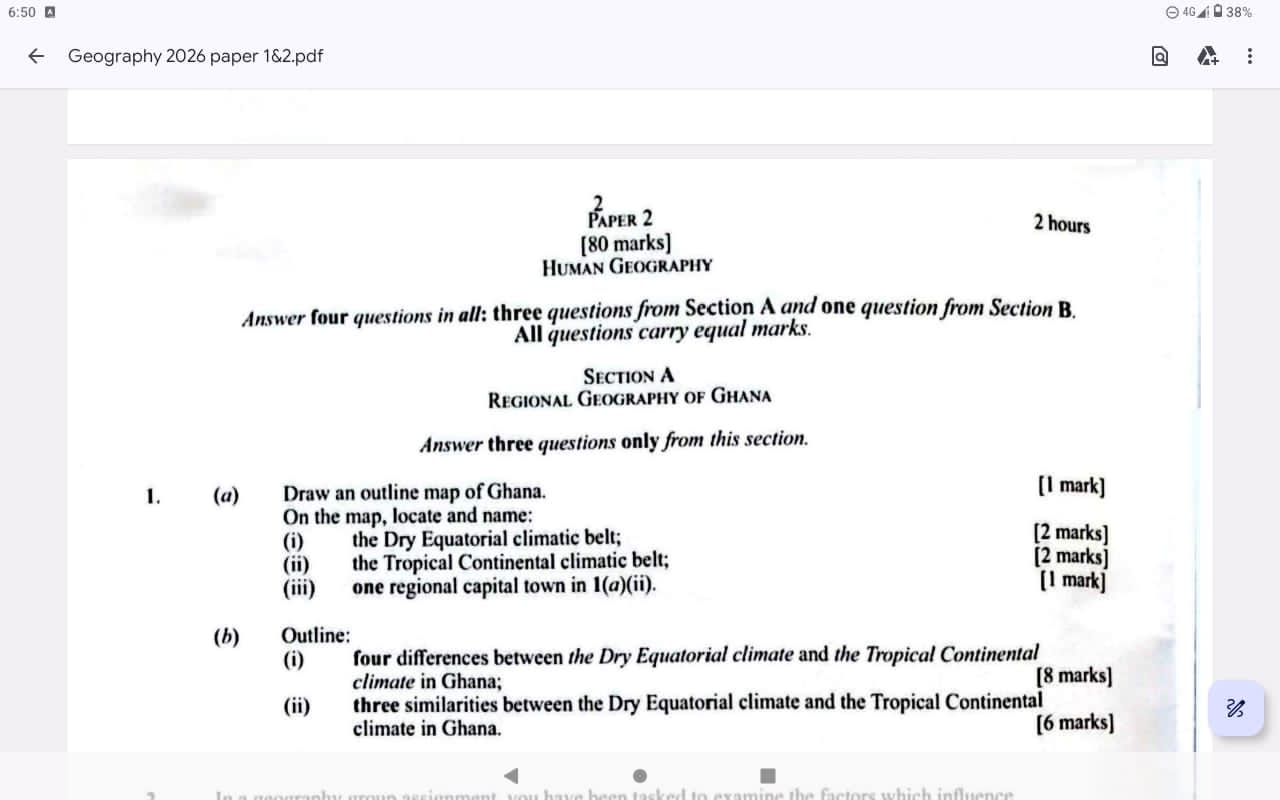
Differences: (1) Dry Equatorial (SE coastal) has higher annual rainfall with two rainy seasons, while Tropical Continental (north) has lower rainfall with one rainy season. (2) Dry Equatorial has higher humidity and more cloud cover; Tropical Continental is drier with lower humidity, especially during the Harmattan. (3) Dry Equatorial has a smaller annual temperature range; Tropical Continental has a larger annual and daily temperature range (hot days, cooler nights in the dry season). (4) Dry Equatorial has a shorter, less intense dry season; Tropical Continental has a long, very dry season with dusty Harmattan winds. Similarities: (1) Both climates have distinct wet and dry seasons. (2) Both are controlled by the seasonal movement of the ITCZ/monsoon winds. (3) Both have generally high temperatures throughout the year compared to temperate climates.
What you are comparing in Ghana
Ghana’s climates vary mainly with latitude and distance from the sea. The Dry Equatorial climate is found in the south-eastern coastal belt (influenced by the Dahomey Gap), while the Tropical Continental climate is typical of northern Ghana, farther inland.
Differences between Dry Equatorial and Tropical Continental
1) Rainfall amount and pattern
- Dry Equatorial (SE Ghana): moderate rainfall for the south, commonly two rainy seasons (major and minor) because the rain belt passes twice.
- Tropical Continental (Northern Ghana): lower total rainfall and usually one rainy season (roughly May/June to Sept/Oct), followed by a long dry season.
2) Length and severity of the dry season
- Dry Equatorial: dry season is shorter and less severe.
- Tropical Continental: dry season is longer and harsher, often about November to March/April.
3) Humidity, cloud cover, and winds
- Dry Equatorial: generally more humid with more frequent cloud cover due to maritime influence.
- Tropical Continental: low humidity in the dry season; the Harmattan (dry, dusty north-east trade wind) is a major feature.
4) Temperature range
- Dry Equatorial: smaller annual temperature range because the nearby ocean moderates temperatures.
- Tropical Continental: larger temperature range (both daily and seasonal) because inland areas heat and cool more quickly.
Similarities between the two climates
1) Seasonal rhythm
Both have a clear wet season and dry season, even though the timing and intensity differ.
2) Same main climate control
Both are shaped by the seasonal shift of the Inter-Tropical Convergence Zone (ITCZ) and the alternating influence of maritime monsoon air and drier continental air.
3) Warm conditions overall
Both climates stay warm to hot for most of the year, since Ghana lies in the tropics.
Quick memory tip
Think: Dry Equatorial = coastal, moderated, two rains; Tropical Continental = inland north, Harmattan, one main rainy season.

- Temperature and Latitude: Equator to Poles True/False
- Polar climates classified by summer temperatures | Geography
- Biggest Desert in the World (MCQ): Sahara or Gobi?
- Fog and Mist as Suspensions vs Precipitation
- How India’s Geography Affects Monsoons and Climate
- Process That Moves Sedimentary Particles (Erosion)
- Vaal River Spatial Object Type (Point, Line, Polygon)
- Short Notes on Cirrus, Nimbostratus, Altostratus
Comments (0)
Please to leave a comment.